
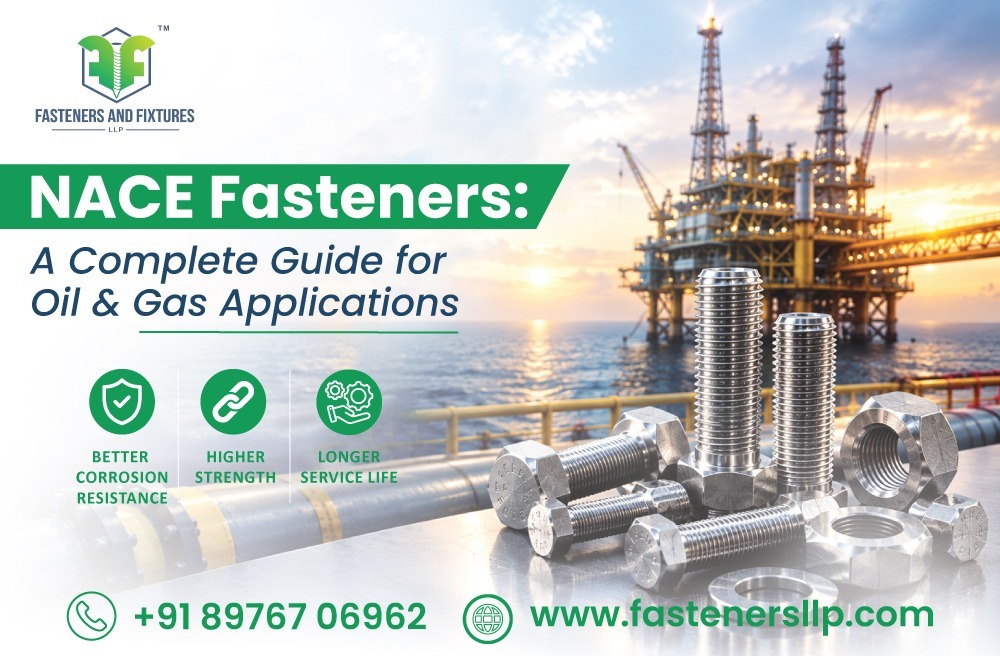
The oil and gas industry operates in some of the most demanding environments, where equipment and fastening systems can be exposed to high pressure, elevated temperatures, hydrogen sulfide (H₂S), chlorides, moisture, and other corrosive conditions. In such applications, conventional fasteners may not provide adequate resistance to corrosion and sulfide stress cracking. NACE fasteners are therefore widely considered for critical oil and gas applications where material selection, hardness control, manufacturing quality, and corrosion resistance are essential.
For companies sourcing fastening solutions for challenging environments, understanding NACE-compliant fasteners, applicable standards, material requirements, and installation considerations is important for maintaining equipment integrity and operational reliability.
What Are NACE Fasteners?
NACE fasteners are fasteners manufactured and supplied to meet applicable requirements established by NACE standards for environments where corrosion and cracking mechanisms can affect metallic components.
NACE International, now part of AMPP (Association for Materials Protection and Performance), developed standards and practices addressing corrosion control and material performance in industries such as oil and gas.
In practical terms, the phrase NACE-compliant fasteners generally refers to fasteners manufactured from suitable materials and processed according to the requirements of the applicable NACE/AMPP specification or project standard.
The exact requirements depend on the application, material grade, environmental conditions, temperature, hardness limits, heat treatment, and applicable specification.
Why Are NACE Fasteners Important?
Oil and gas production can involve environments containing H₂S, commonly referred to as sour service. Hydrogen sulfide can contribute to material degradation and cracking under certain conditions.
Fasteners are particularly important because they are used to join pressure-containing equipment, pipelines, valves, flanges, fittings, pumps, and structural components. A fastening failure can compromise the integrity of an entire assembly.
Using appropriately specified NACE fasteners for oil and gas applications can help address risks associated with:
- Sulfide stress cracking (SSC)
- Hydrogen-induced cracking (HIC), where applicable
- General and localized corrosion
- High-pressure service
- Sour-service environments
- Temperature variations
- Aggressive chemical exposure
However, NACE compliance should never be treated as simply selecting a particular stainless steel or alloy. The complete material specification and manufacturing process must be evaluated against the applicable standard.
Who Uses NACE Compliant Fasteners?
NACE-compliant fasteners are primarily used by industries where equipment operates in corrosive or sour-service environments. Typical users include:
- Oil and gas exploration companies
- Refineries
- Petrochemical plants
- Offshore drilling facilities
- Onshore production facilities
- Pipeline operators
- LNG facilities
- Chemical processing plants
- Engineering, procurement and construction (EPC) companies
- Valve and flange manufacturers
- Pressure vessel manufacturers
For procurement teams, selecting fasteners based on the equipment specification and service environment is essential rather than relying solely on a generic “NACE” designation.
Where Are NACE Fasteners Used?
NACE fasteners for oil and gas are commonly specified for critical equipment and connections, including:
1. Pipelines
Pipeline flanges, valve connections, and other mechanical joints may require fasteners suitable for corrosive or sour-service environments.
2. Oil & Gas Valves
Gate valves, globe valves, ball valves, check valves, and other equipment may use specially selected bolting for demanding service conditions.
3. Pressure Vessels
Pressure vessels can require carefully specified bolting materials to maintain mechanical integrity under pressure and corrosive exposure.
4. Flanges
Flanged connections depend on properly selected bolts, nuts, and washers to maintain joint integrity.
5. Offshore Platforms
Offshore equipment is exposed to seawater, humidity, chlorides, and potentially aggressive process environments, making material selection especially important.
6. Refineries and Petrochemical Plants
Processing equipment can encounter combinations of high temperatures, chemicals, hydrogen sulfide, and other corrosive substances.
When Should You Use NACE Fasteners?
NACE-compliant or sour-service fasteners should be considered when the project specification identifies NACE/AMPP requirements or when the equipment operates in an environment where sulfide stress cracking and related corrosion mechanisms are credible risks.
The decision should consider:
- Presence and concentration of H₂S
- Temperature
- Pressure
- Chloride exposure
- pH
- Material composition
- Required mechanical properties
- Hardness requirements
- Heat-treatment condition
- Environmental severity
- Applicable project specification
It is important to note that NACE compliance is application- and specification-dependent. A fastener should not be described as compliant without verifying the relevant standard and manufacturing documentation.
How Are NACE Fasteners Manufactured?
Manufacturing quality plays a major role in the performance of NACE fasteners.
Depending on the specified material and standard, production can involve controlled:
- Raw material selection
- Forging or cold forming
- Heat treatment
- Threading
- Hardness control
- Machining and finishing
- Inspection and testing
- Certification and traceability
Hardness control is particularly important for many sour-service applications because excessive hardness can increase susceptibility to sulfide stress cracking in susceptible materials.
Manufacturers and suppliers may also provide material test certificates, heat-treatment records, chemical composition data, mechanical test results, hardness results, and other documentation required by the purchase specification.
Common Materials for NACE Fasteners
The appropriate material depends on the service environment and applicable specification. Potential material categories include selected carbon and low-alloy steels, stainless steels, and corrosion-resistant alloys.
Examples may include:
- Carbon steel fasteners
- Low-alloy steel fasteners
- Stainless steel fasteners
- Duplex stainless steel fasteners
- Nickel alloy fasteners
- Other corrosion-resistant alloys
The material should be selected based on the actual service conditions and the applicable NACE/AMPP requirements rather than simply choosing an alloy because it has high corrosion resistance.
Benefits of NACE Fasteners
Properly specified NACE fasteners can offer several benefits for oil and gas applications:
Improved resistance to sour-service damage: Appropriate materials and processing can reduce susceptibility to cracking mechanisms addressed by the applicable standard.
Enhanced equipment integrity: Correctly specified bolting helps maintain reliable mechanical joints.
Better suitability for corrosive environments: Material selection can address challenging chemical and environmental conditions.
Traceability: Certified fasteners can provide documentation supporting material and manufacturing requirements.
Reduced operational risk: Proper engineering and specification can reduce the likelihood of premature fastening-system failure.
What Should You Check Before Buying NACE Fasteners?
Before purchasing NACE fasteners, buyers should verify:
- Applicable NACE/AMPP standard
- Fastener grade
- Material specification
- Diameter and thread configuration
- Mechanical properties
- Hardness requirements
- Heat-treatment requirements
- Corrosion environment
- H₂S exposure
- Temperature and pressure
- Inspection and testing requirements
- Material Test Certificate (MTC)
- Heat number and traceability
- Coating or surface-treatment requirements
Working with an experienced fastener supplier can help ensure that the supplied products match the engineering and procurement specification.
NACE Fasteners for Oil and Gas: Choosing the Right Solution
Selecting NACE-compliant fasteners is more than choosing a corrosion-resistant bolt. It requires an understanding of the operating environment, material properties, applicable standards, manufacturing processes, and documentation requirements.
For oil and gas projects, the correct fastening solution should be determined from the equipment design and project specification. Factors such as H₂S exposure, temperature, pressure, material grade, hardness, and heat treatment can all influence the final selection.
Fasteners and Fixtures LLP can support industries requiring engineered fastening solutions by helping customers identify fasteners according to application, material, dimensions, and project requirements. For critical oil and gas applications, customers should provide the applicable technical specification so the fastener can be evaluated against the required NACE/AMPP criteria.
NACE fasteners play an important role in maintaining the integrity of mechanical connections in demanding oil and gas environments. When properly specified, manufactured, tested, and documented, NACE-compliant fasteners can provide a suitable fastening solution for sour-service and corrosive applications.
For reliable procurement, always match the fastener material and manufacturing requirements to the applicable NACE/AMPP standard and project specification. Fasteners and Fixtures LLP can assist customers in sourcing application-specific fastening solutions for oil and gas and other demanding industrial environments.
1. What are NACE fasteners?
NACE fasteners are fasteners manufactured and specified for applications requiring compliance with applicable NACE/AMPP requirements, particularly environments where sour-service corrosion and sulfide stress cracking may be concerns.
2. What are NACE-compliant fasteners used for?
NACE-compliant fasteners are commonly used in oil and gas, petrochemical, refinery, pipeline, offshore, and other applications involving corrosive or sour-service environments.
3. Are NACE fasteners suitable for oil and gas applications?
Yes, appropriately specified NACE fasteners for oil and gas can be used for critical equipment and connections exposed to sour-service or corrosive environments. The applicable standard and service conditions must be verified before selection.
4. Which materials are used for NACE fasteners?
Depending on the application and applicable requirements, NACE fasteners may be manufactured from selected carbon steels, low-alloy steels, stainless steels, duplex stainless steels, nickel alloys, and other corrosion-resistant materials.
5. How do I choose NACE-compliant fasteners?
Choose NACE-compliant fasteners based on the applicable NACE/AMPP specification, H₂S exposure, temperature, pressure, material grade, hardness, heat treatment, dimensions, mechanical requirements, and required certification and traceability.