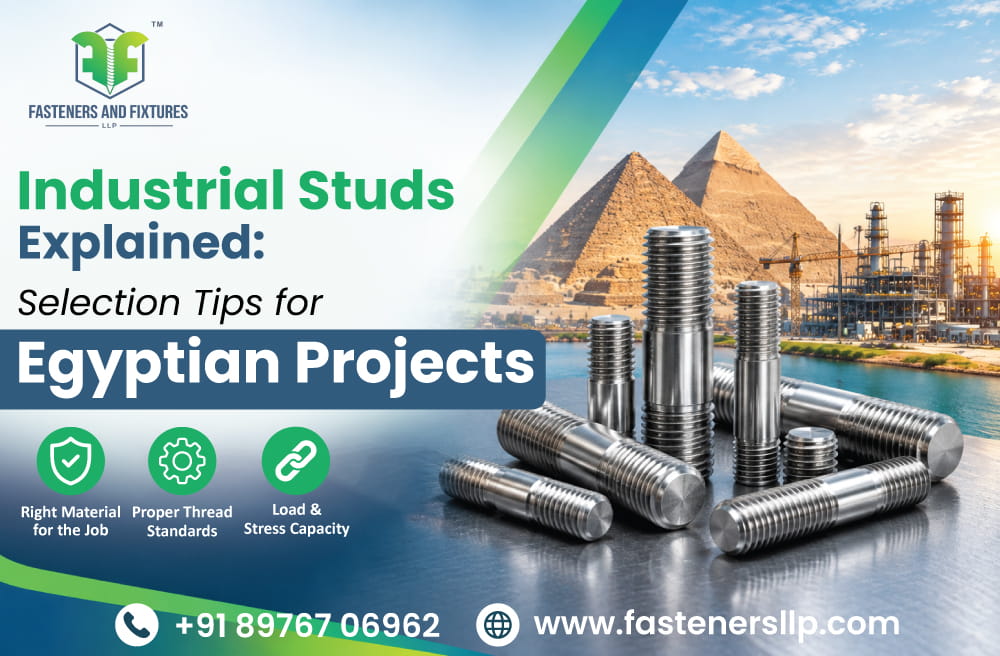
When an industrial project takes shape, attention often goes to large machinery, structural steel, pipelines, and sophisticated equipment. However, experienced project engineers understand that the smallest components can have a significant impact on overall performance. Industrial studs are among these essential components, helping secure connections across demanding industrial environments.
From oil and gas facilities to construction sites, petrochemical plants, power stations, and manufacturing units, industrial studs play an important role in creating reliable bolted connections. In Egypt, where infrastructure development and industrial operations require dependable fastening solutions, selecting the right stud is an important engineering decision.
For project procurement teams, the challenge is not simply finding a supplier. It is identifying the correct material, dimensions, thread specifications, coating, and mechanical properties for the intended application.
At Fasteners and Fixtures LLP, the selection process begins with understanding the project rather than treating every fastening requirement as identical. Working with experienced stud manufacturers in Egypt and qualified suppliers can help businesses source components that meet their technical requirements, support installation efficiency, and deliver dependable performance.
What Are Industrial Studs?
Industrial studs are threaded metal fasteners designed to secure components using nuts, often with washers where required. Unlike conventional bolts, which generally have a head at one end, studs typically feature external threads along part or all of their length.
Depending on the design, a stud may be threaded at both ends, threaded along its entire length, or manufactured with a particular configuration for a specialised application.
Studs are commonly used in:
- Oil and gas processing facilities
- Petrochemical plants and refineries
- Industrial pipelines and pressure equipment
- Power generation facilities
- Structural steel installations
- Heavy machinery and manufacturing equipment
- Flanges, valves, and industrial assemblies
Their suitability depends on the engineering design, applied loads, operating temperature, corrosion exposure, and relevant industry standards.
Why Choosing the Right Stud Manufacturer in Egypt Matters
Egypt’s industrial landscape includes energy infrastructure, manufacturing facilities, construction projects, and processing industries. Each application can introduce different mechanical and environmental demands.
For example, a stud used in a pipeline flange may need to withstand specified preload, pressure-related forces, temperature variations, and exposure to a corrosive environment. A stud used in structural equipment may have different strength, dimensional, and coating requirements.
This is why project buyers should evaluate stud manufacturers in Egypt based on technical capability, material traceability, quality assurance, and the ability to supply products against approved specifications.
At Fasteners and Fixtures LLP, the purchasing approach focuses on aligning fastening requirements with application conditions. For buyers evaluating manufacturers or suppliers, a detailed technical discussion before ordering can reduce the risk of receiving unsuitable components.
Five Essential Tips for Selecting Industrial Studs
1. Choose the Correct Material Grade
Material selection is one of the first decisions engineers should make. Carbon steel, alloy steel, and stainless steel studs serve different purposes depending on strength requirements, operating temperatures, and environmental exposure.
Carbon steel studs may be appropriate for many general industrial applications when the specified grade and protective finish meet the service conditions. Alloy steel can be selected where particular mechanical properties or temperature-related requirements apply. Stainless steel may be suitable for certain corrosive environments, although the correct grade must be assessed against the specific chemicals and operating conditions.
For Egyptian projects involving coastal locations, chemical processing, or outdoor installations, corrosion assessment deserves particular attention.
The correct material should always be selected according to the engineering specification, applicable standards, and compatibility with the connected components.
2. Verify Thread Dimensions and Stud Length
A high-quality stud can still create installation problems if its dimensions are incorrect.
Before placing an order, procurement teams should confirm the nominal diameter, thread pitch, overall length, thread length, and required tolerances. Metric and imperial threads should not be interchanged without engineering approval.
The selected length must also accommodate the connected components, any specified gaskets and washers, and the required nut engagement.
For flange assemblies, buyers should verify the applicable flange standard, pressure class, dimensions, and bolting requirements. Accurate measurements help prevent delays, rework, and assembly difficulties on site.
3. Match Mechanical Properties to Operating Loads
Industrial studs must be suitable for the loads they are expected to carry. Depending on the application, these may include tensile loads, preload, vibration, thermal cycling, and other service-related stresses.
Engineers should verify the specified property class or material grade, tensile requirements, and any applicable testing requirements.
It is equally important to consider the complete fastening assembly. Studs, nuts, washers, and connected components must be compatible with the intended design.
For critical applications, selection should follow approved engineering calculations and relevant codes rather than relying on appearance or price alone.
4. Evaluate Corrosion Protection and Operating Conditions
Egyptian industrial projects may operate in coastal, desert, humid, or chemically aggressive environments. These conditions can influence the choice of material and surface protection.
Depending on the application, available options may include suitable metallic coatings, other specified protective finishes, or corrosion-resistant alloys.
However, coatings must be compatible with the fastener’s material, service temperature, installation method, and required thread fit. Some high-strength fasteners also require specific precautions during coating processes.
Buyers should assess the actual service environment and consult the project specification before choosing a protective finish. Corrosion resistance should never be assumed simply because a stud has a particular colour or coating.
5. Check Quality Documentation and Supply Reliability
A dependable fastening solution involves more than the physical product. Buyers should examine whether the manufacturer or supplier can provide the documentation required for the project.
Depending on the purchase specification, this may include material test certificates, dimensional inspection reports, mechanical test results, chemical composition reports, coating documentation, and traceability records.
Relevant standards may include ASTM, ASME, ISO, or other project-approved specifications, depending on the stud type and application. The precise standard must match the component being purchased.
Procurement teams should also confirm lead times, order quantities, packaging, identification, and delivery schedules. For projects operating under tight deadlines, reliable communication and documented quality processes can be as important as competitive pricing.
How Fastners and Fixtures LLP Supports Industrial Fastening Requirements
Fastners and Fixtures LLP recognises that industrial buyers need fastening solutions that match their technical and commercial requirements.
When evaluating stud sourcing options, project teams should begin by sharing the application, required dimensions, material grade, applicable standard, operating conditions, quantity, and inspection requirements.
This information allows the supplier to assess the request more accurately and clarify any missing specifications before an order is finalised.
For businesses sourcing products through stud manufacturers in Egypt, the goal should be to establish a supply relationship based on specification compliance, product consistency, transparent communication, and dependable delivery.
Rather than choosing solely on the lowest quoted price, procurement professionals should compare the complete offering, including documentation, quality assurance, technical suitability, and total project cost.
Industrial studs may be small components, but their performance can influence the reliability of critical connections throughout an industrial facility.
For projects in Egypt, successful selection begins with understanding the application, choosing the appropriate material, confirming thread dimensions, checking mechanical requirements, and evaluating corrosion protection. Quality documentation and dependable supply arrangements complete the process.
Fasteners and Fixtures LLP | Leading stud manufacturers in Egypt encourages industrial buyers to approach fastening procurement as a technical decision rather than a routine purchasing exercise. By working with qualified suppliers and verifying every critical specification, project teams can improve installation readiness and support long-term equipment reliability.
The right industrial stud is not necessarily the most expensive or the cheapest option. It is the component that meets the approved specification and performs as intended under the conditions for which it was selected.
Frequently Asked Questions (FAQs)
1. What are industrial studs used for in Egyptian projects?
Industrial studs are used to secure flanges, pipelines, machinery, structural assemblies, pressure equipment, and other industrial components. Their suitability depends on the specified dimensions, material grade, mechanical properties, and operating conditions.
2. How can buyers choose reliable stud manufacturers in Egypt?
Buyers should assess technical expertise, manufacturing or sourcing capabilities, material traceability, quality-control procedures, compliance with relevant standards, documentation, delivery commitments, and customer support. Supplier claims should be verified against the project’s actual requirements.
3. Which material is best for industrial studs?
There is no single material suitable for every application. Carbon steel, alloy steel, and stainless steel may be appropriate depending on mechanical loads, temperature, corrosion exposure, and the governing specification. Engineers should approve the material before procurement.
4. Which standards should industrial studs meet?
The applicable standard depends on the stud’s design and intended use. ASTM, ASME, ISO, and other recognised specifications may apply. Buyers should confirm the exact standard, grade, dimensions, and testing requirements stated in the project’s engineering documents.
5. What information is required when requesting a quotation for industrial studs?
A useful enquiry should include the stud type, diameter, length, thread specification, material grade, applicable standard, coating requirements, quantity, operating environment, inspection documentation, and delivery destination. Drawings or a bill of materials can help suppliers evaluate the requirement accurately.
About Fastners and Fixtures LLP
Fasteners and Fixtures LLP focuses on industrial fastening requirements, helping buyers evaluate fastening products against project specifications and application needs. For industrial projects in Egypt, clear technical documentation and careful supplier evaluation remain essential steps towards reliable fastening procurement.