
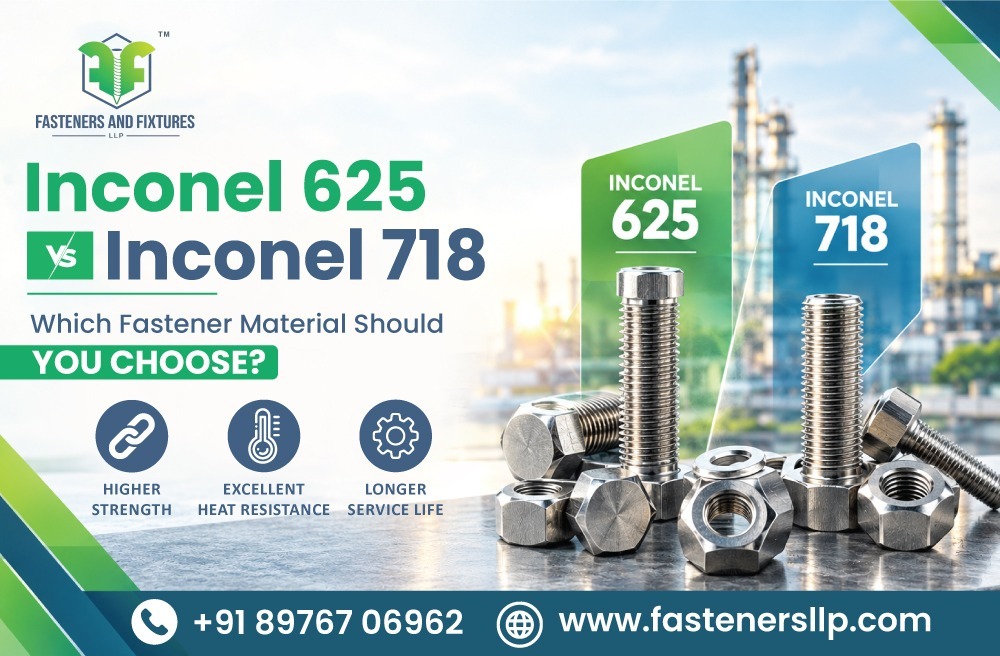
Choosing the right fastener material is critical when components must withstand high temperatures, corrosive environments, pressure, vibration, and demanding mechanical loads. Two nickel-based superalloys frequently considered for these applications are Inconel 625 and Inconel 718.
But when comparing Inconel 625 vs 718, which alloy is more appropriate for fasteners? The answer depends on the operating environment, required mechanical properties, temperature, corrosion exposure, fabrication requirements, and applicable standards.
In this guide, we at Fasteners and Fixtures LLP explain the differences between Inconel 625 and Inconel 718.
What Are Inconel 625 and Inconel 718?
Inconel 625 is a nickel-chromium-molybdenum alloy known for excellent corrosion resistance, high strength, and resistance to pitting, crevice corrosion, and stress-corrosion cracking. Its composition makes it particularly useful in aggressive chemical, marine, oil and gas, and aerospace environments.
Inconel 718 is a precipitation-hardening nickel-iron-chromium alloy designed to provide very high strength, particularly at elevated temperatures. It contains elements such as niobium, molybdenum, titanium, and aluminum that contribute to its precipitation-hardening characteristics.
For fasteners, both alloys can provide performance beyond that of many conventional stainless steels and carbon steels, but their strengths lie in somewhat different areas.
Why Compare Inconel 625 vs 718 for Fasteners?
Fasteners often operate under conditions where failure can have serious consequences. Bolts, nuts, screws, studs, and other threaded components may be exposed to heat, chemicals, seawater, pressure, cyclic loading, and mechanical stress.
The Inconel 625 vs 718 comparison is therefore important because the alloys offer different combinations of corrosion resistance, strength, temperature capability, and manufacturing characteristics.
A simplified way to view the distinction is:
- Inconel 625: Strong emphasis on corrosion resistance and versatility.
- Inconel 718: Strong emphasis on high mechanical strength and high-temperature performance.
However, actual suitability depends on the specific application and specification.
Who Uses Inconel 625 and Inconel 718 Fasteners?
Inconel fasteners are generally selected by industries where conventional fastener materials may not provide sufficient performance.
Typical users include:
- Oil and gas companies
- Petrochemical and chemical-processing industries
- Aerospace manufacturers
- Power-generation companies
- Marine and offshore industries
- Nuclear and energy-sector applications
- Industrial equipment manufacturers
- Engineering and fabrication companies
Design engineers, maintenance teams, procurement departments, and fastener manufacturers may all be involved in selecting between Inconel 625 and Inconel 718.
Where Are Inconel 625 Fasteners Used?
Inconel 625 fasteners are particularly useful where corrosion resistance is a primary consideration.
Typical applications include:
- Offshore oil and gas equipment
- Chemical-processing equipment
- Seawater systems
- Marine equipment
- Heat exchangers
- Exhaust systems
- Pressure-control equipment
- Pollution-control equipment
- Components exposed to corrosive chemicals
The alloy’s resistance to localized corrosion makes it useful in chloride-containing and other aggressive environments.
Where Are Inconel 718 Fasteners Used?
Inconel 718 fasteners are commonly considered for applications requiring very high strength combined with elevated-temperature capability.
Potential applications include:
- Aerospace engines
- Gas turbines
- High-temperature industrial equipment
- Power-generation systems
- High-stress bolting applications
- Engine and propulsion components
- Components subjected to cyclic mechanical loading
Its precipitation-hardening capability allows Inconel 718 to achieve high strength after appropriate heat treatment.
When Should You Choose Inconel 625?
Choose Inconel 625 when corrosion resistance is one of the dominant design requirements and the application also demands good strength and temperature resistance.
It can be particularly attractive when fasteners will encounter:
- Chloride-containing environments
- Seawater or marine exposure
- Aggressive chemicals
- Pitting and crevice-corrosion risks
- High-temperature corrosive conditions
- A combination of mechanical and environmental stresses
For example, an offshore application exposed to seawater may place greater emphasis on corrosion resistance than maximum tensile strength. In such circumstances, Inconel 625 may be considered.
When Should You Choose Inconel 718?
Inconel 718 becomes a strong candidate when high mechanical strength and elevated-temperature performance are central requirements.
It may be considered for applications involving:
- High tensile and yield-strength requirements
- High mechanical loads
- Elevated temperatures
- Cyclic loading
- Aerospace applications
- High-performance rotating or engine-related equipment
The precipitation-hardening characteristics of Inconel 718 allow it to deliver very high strength compared with many conventional nickel alloys.
How Do Inconel 625 and 718 Compare?
| Property / Consideration | Inconel 625 | Inconel 718 |
| Alloy family | Nickel-chromium-molybdenum | Nickel-iron-chromium |
| Primary advantage | Corrosion resistance and versatility | Very high strength |
| Strength | High | Very high after appropriate heat treatment |
| Corrosion resistance | Excellent | Very good |
| High-temperature capability | Excellent for many corrosive applications | Excellent for high-strength applications |
| Precipitation hardening | Not normally the primary strengthening mechanism | Yes |
| Marine environments | Highly suitable | Application-dependent |
| Aerospace applications | Used in demanding environments | Widely used where high strength is required |
| Manufacturing considerations | Generally easier to fabricate than precipitation-hardened grades | More demanding processing and heat treatment |
| Typical selection driver | Corrosion resistance | Strength and temperature |
These are general material-selection considerations. The exact grade, product form, heat treatment, dimensions, service conditions, and applicable specification should always be evaluated before final selection.
Inconel 625 vs 718: Which Is Better for Fasteners?
There is no universal answer to which alloy is “better.” The appropriate choice depends on the application’s priorities.
Inconel 625 may be considered when corrosion resistance, particularly resistance to localized corrosion and aggressive environments, is the major concern.
Inconel 718 may be considered when maximum mechanical strength and high-temperature load-bearing capability are more important.
Other factors should also be evaluated, including operating temperature, chemical exposure, stress levels, fatigue requirements, fabrication method, heat treatment, thread configuration, dimensional requirements, availability, and cost.
How Should You Select the Right Inconel Fastener?
Before ordering an Inconel fastener, define the complete service environment.
Ask these six questions:
What loads and temperatures will the fastener experience?
Why is a nickel-based superalloy required instead of stainless steel or another material?
Who is responsible for approving the material and applicable specification?
Where will the fastener operate — offshore, chemical, aerospace, marine, or industrial?
When will the fastener experience peak temperature, pressure, vibration, or corrosion exposure?
How will the fastener be manufactured, heat-treated, inspected, and installed?
This approach helps prevent selecting an alloy solely based on tensile strength or price.
The comparison of Inconel 625 vs 718 ultimately comes down to application requirements. Inconel 625 offers an outstanding combination of corrosion resistance, strength, and versatility, making it suitable for many aggressive environments. Inconel 718 provides exceptionally high strength and is particularly relevant to demanding high-temperature and high-load applications.
For critical fasteners, material selection should be based on engineering requirements rather than alloy name alone. The required specification, heat treatment, dimensions, service conditions, and quality requirements should all be verified before procurement.
Fasteners and Fixtures LLP can help customers evaluate nickel-alloy fastener requirements and identify suitable fastener solutions based on application and specification requirements.
1. What is the main difference between Inconel 625 and Inconel 718?
The main distinction is their performance emphasis. Inconel 625 is renowned for excellent corrosion resistance and versatile high-temperature performance, while Inconel 718 is known for very high mechanical strength achieved through precipitation hardening.
2. Is Inconel 625 stronger than Inconel 718?
In many product conditions, Inconel 718 can achieve higher strength than Inconel 625 because of its precipitation-hardening mechanism. However, strength alone should not determine fastener selection because corrosion resistance and service conditions are also important.
3. Is Inconel 625 suitable for oil and gas fasteners?
Yes. Inconel 625 fasteners can be suitable for demanding oil and gas environments where corrosion resistance, mechanical strength, and resistance to aggressive media are required. The specific application and applicable material specification must be verified.
4. Why is Inconel 718 used for high-temperature fasteners?
Inconel 718 is used in demanding high-temperature applications because it can provide very high strength and good resistance to mechanical degradation at elevated temperatures when supplied in the appropriate heat-treated condition.
5. How do I choose between Inconel 625 and Inconel 718 fasteners?
Consider operating temperature, tensile and yield-strength requirements, corrosion exposure, fatigue and cyclic loading, installation conditions, manufacturing requirements, applicable standards, and total cost. A qualified materials or design engineer should verify the final selection for critical applications.