
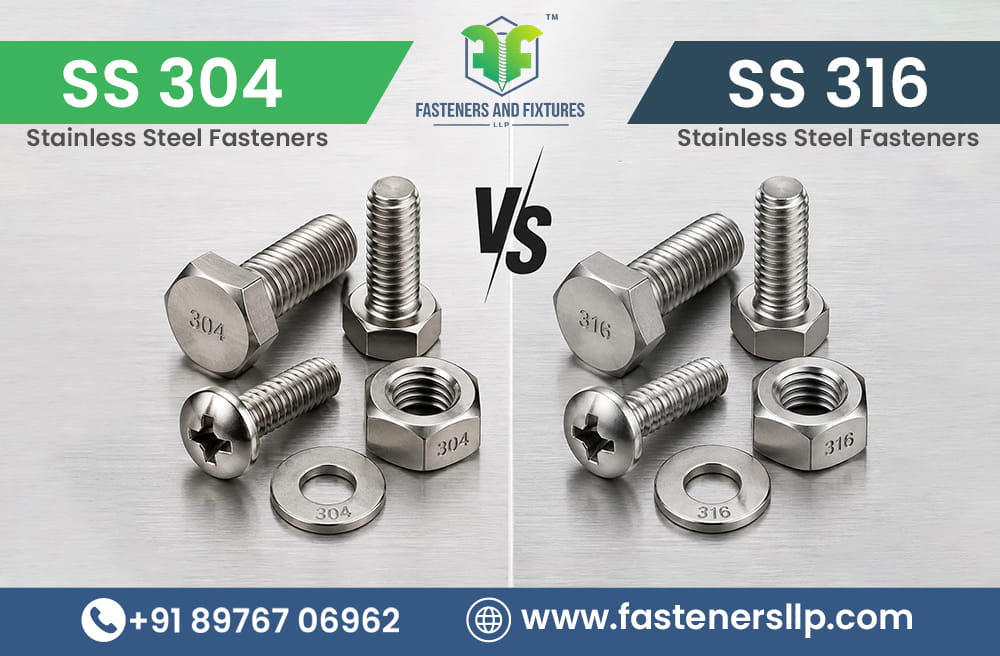
Fasteners made of stainless steel are widely employed in engineering, construction, automotive, marine, food processing, industrial, and architectural applications due to their durability, strength, and resistance. The most frequently used kinds are SS 304 and SS. Although both are part of an austenitic stainless steel class, their composition and properties make them appropriate for various situations.
Understanding the difference between SS 304 and SS 316 is essential when selecting nuts, bolts, washers, screws, and other fastening components that fasten. The correct grade will increase the life of your service, decrease maintenance, and offer better resistance to the most demanding operating conditions.
SS 304 vs SS 316: What Is the Difference?
SS 304 is one of the most popular types of stainless steel. It has good resistance to corrosion, shapeability, strength, and value, making it a good all-purpose stainless steel material for fasteners.
SS 316 provides enhanced corrosion resistance since it is made up of molybdenum. This makes it ideal for areas that have chlorides, saltwater, chemicals, and other conditions that cause corrosion.
In simple words, SS 304 is an excellent choice for general-purpose use, and SS 316 is generally preferred for environments that are more abrasive.
SS 304 vs SS 316 Chemical Composition:
The major difference is apparent when you compare SS 304 and SS 316 chemical composition.
SS 304 primarily contains iron along with nickel and chromium, with chromium providing resistance to corrosion and nickel enhancing its austenitic structure and strength.
SS 316 contains chromium and nickel too; however, it also has around 2 percent molybdenum. This extra element greatly enhances the resistance to pitting as well as crevice corrosion, specifically in chloride-rich environments.
Common compositions include:
| Element | SS 304 | SS 316 |
| Chromium | ~18-20% | ~16-18% |
| Nickel | ~8-10.5% | ~10-14% |
| Molybdenum | Not deliberately included | ~2-3% |
| Iron | Balance | Balance |
Limits can be different in accordance with the applicable standard and the product’s specifications. So, it is important to examine the certification of the material as well as relevant grade specifications for critical applications.
Stainless Steel 304 vs 316 Strength:
When it comes to comparing Stainless Steel 304 vs 316 strength, the differences are not always that dramatic. Both grades provide high mechanical properties, durability, and resistance to a variety of conditions of use.
SS 304 is widely used in situations where strength and corrosion resistance are required, but without exposure to extremely aggressive conditions. SS 316 can provide comparable mechanical performance, while also offering greater resistance to corrosion.
For fasteners, however, strength is not the only selection factor. Thread design, the class of the fastener manufacturing procedure, heat treatment where necessary, dimensions, and load conditions can all impact the performance.
Therefore, deciding between SS 304 and SS 316 shouldn’t be solely based on strength. The environment around you is usually the most important factor.
Types of Stainless Steel Fasteners:
Fasteners come in a variety of designs to meet various requirements for joining. Some of the popular Types of Stainless Steel Fasteners available in the market are given below:
- Stainless Steel Bolts: They are used for mechanical and structural assemblies.
- Stainless Steel Nuts: They are paired with bolts to ensure strong threaded connections.
- Stainless Steel Screws: They are suitable for machine fabrication, equipment, or general assembly.
- Stainless Steel Washers: Help distribute loads and protect surfaces adjacent to them.
- Threaded rods and studs are used for pipe, equipment, or industrial components.
- Self-Tapping Screws: They are useful when the fastener is able to create or engage threads in the course of installation.
The right grade of fastener should be chosen based on the purpose, the environment, loads, and the relevant standards.
SS 316 vs SS 304: Which One Should You Choose?
The answer is contingent on the specific application.
Select SS304 for the following reasons:
- General resistance to corrosion
- Affordable stainless steel fasteners made from stainless steel
- Applications for moderately corrosive or indoor environments
- Applications for construction and fabrication
- Kitchen-related and food-processing environments
- General assembly of machinery and equipment
Select SS316 to get:
- Greater resistance to exposure to chlorides
- Superior performance in the marine environment
- Better resistance to crevice and pitting corrosion
- Chemical processing applications
- Coastal construction
- Outdoor applications exposed to harsh weather conditions
SS 316 generally costs more than SS 304 because of its alloying composition. However, the extra corrosion resistance could justify the expense, especially in situations where the failure of a fastener prematurely may result in maintenance costs or other operational issues.
Stainless Steel 304 vs 316 for Water Bottle:
The contrast between stainless steel 304 and the 316 used to be used in water bottle applications is also standard. SS 304 is extensively used for beverage and food containers as it has good anti-corrosion properties and it is suitable for a variety of common applications.
SS 316 can offer additional corrosion resistance, particularly if exposure to salts or other aggressive liquids are a problem. However, for normal drinking-water applications, SS 304 is often sufficient if it is well-constructed and maintained.
The same principles apply to fasteners. The best quality is determined by actual conditions of use rather than simply selecting the more costly material.
Stainless Steel 304 vs 316 for Jewelry:
The expression stainless steel304 and 316 for jewelry generally refers to the appearance as well as durability, skin-contact issues, and corrosion resistance.
Both grades provide the durability of stainless steel surfaces; however, SS 316 and its variants are typically chosen for use that requires greater resistance to corrosion. Jewellery exposed to moisture, sweat and environmental pollutants can benefit from an alloy that is resistant to corrosion.
For other skin-contact products, purchasers should be aware of the specific specifications for the product as well as the finish of the surface and any applicable safety standards rather than deciding on an item based solely on the basis of its name.
Uses of SS 304 and SS 316 Fasteners:
SS 304 fasteners are commonly employed in machines, architectural fabrication, food processing equipment, automotive components, furniture, general engineering, and other areas.
SS 316 fasteners are particularly suitable for marine structures, marine equipment, chemical processing facilities, pharmaceutical plants, water-treatment equipment, outdoor structures and installations which are exposed to chlorides.
A proper selection of materials can help to avoid corrosion-related issues such as pitting, staining, thread loss, and the rapid loss of integrity in fastening.
Why Choose Fastnersllp?
Choosing the right supplier of fasteners is as important as choosing the correct grades of stainless steel. Fastnersllp could be a viable option for a business seeking stainless steel fastening options based on requirements for the application, dimensions, grades, and specifications.
A reputable supplier must be able to aid customers in finding the appropriate fastener type, materials, grades, sizes, and finishes, as well as appropriate standards. For industrial applications that require a lot of effort, documents like the certification of material and specifications compliance are also important.
If the need is SS 304 or SS 316, buyers should concentrate on the same quality, precision in dimensional measurement, the right material selection, and reliable supply.
The decision of SS 304 and SS 316 stainless steel fasteners will ultimately depend on the operational environment. SS 304 is an excellent stainless steel that is general-purpose and offers the best balance between corrosion resistance, durability, and cost. SS 316, with its molybdenum percentage, is more suitable for applications involving marine conditions, chlorides, and more corrosive environments that are more severe.
Understanding SS 316 vs SS 304 and their chemical structure, strength types, and applications will help engineers, manufacturers, as well as procurement departments, make more informed selections. By assessing the conditions and loading requirements, as well as the specifications and the expected life of service, it is possible to select the correct stainless steel fastener to suit your specific application.
1. What is the primary distinction that separates SS 304 and SS 316 fasteners?
The main difference is the chemical composition. SS 316 contains molybdenum, which gives it better resistance to crevice and pitting corrosion, particularly in chloride-rich environments. SS 304 is generally preferred in a wide range of applications due to the fact that it provides excellent corrosion resistance and a cost that is a bit lower.
2. Are SS 316 stronger than SS 304?
SS 316 and SS 304 have mechanical properties that are broadly similar; however, their strength is contingent on the condition and the specifications. For fasteners, the necessary grade, standard, and application load should be taken into consideration instead of thinking it is the case that SS 316 is always stronger.
3. Which one is better for marine and outdoor bolts, SS 304 or SS 316?
SS 316 is generally the most preferred option for chloride-sensitive marine and high-chloride environments because of its molybdenum content. offers increased resistance to crevice and pitting corrosion.
4. Are SS 304 suitable for water bottles or food-related uses?
Yes. SS 304 is widely used in the food and beverage industry due to its resistance to corrosion and its suitability for a variety of everyday conditions. However, the product must meet the applicable requirements for food contact.
5. What are the differences between SS 304 and SS 316 stainless steel fasteners?
Take into consideration the environment that you are in, such as exposure to chlorides or chemicals, temperatures, and mechanical loads, the required service life, applicable, standards and budget. For general use, SS 304 is often acceptable, while SS 316 is generally advantageous for more corrosive environments. Fasteners LLP is a resource for buyers to determine the right type of fastener and specification of the material for their needs.