
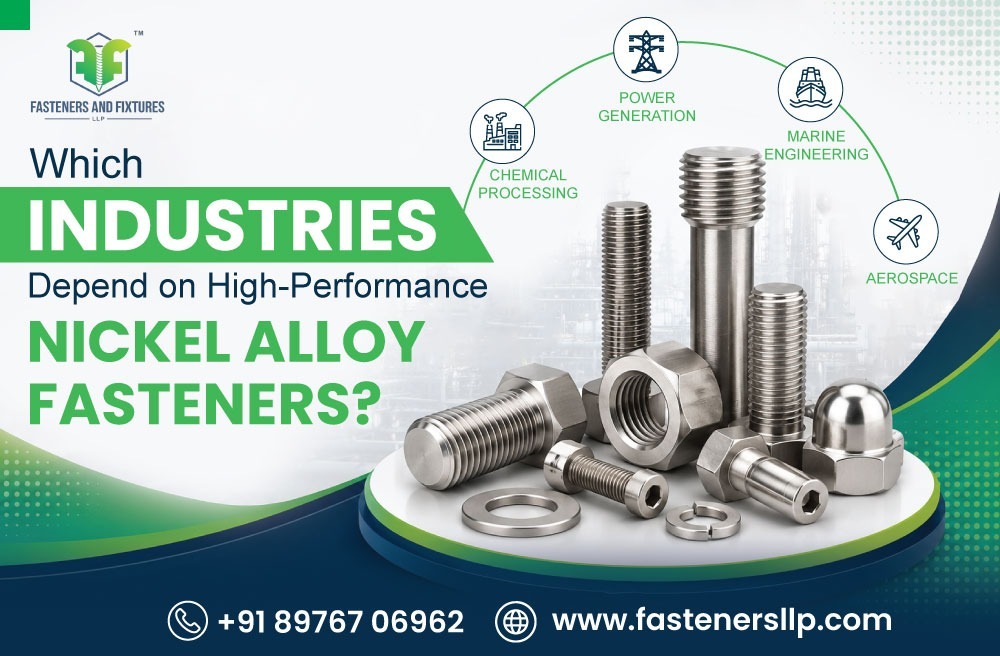
In demanding industrial environments, ordinary fasteners may not provide the strength, corrosion resistance, and temperature stability required for reliable performance. This is where nickel alloy fasteners become essential. Designed to withstand aggressive chemicals, extreme temperatures, pressure, and corrosive conditions, nickel-based fasteners are widely used across industries where component failure can lead to significant safety, maintenance, and operational challenges.
Among the most recognized solutions are Inconel fasteners, which are valued for their exceptional mechanical performance at elevated temperatures. For industries operating in challenging environments, selecting the right fastener material is just as important as selecting the right structural or equipment material.
For businesses looking for dependable industrial fastening solutions, Fastnersllp offers nickel alloy fasteners suitable for a wide range of demanding applications.
What Are Nickel Alloy Fasteners?
Nickel alloy fasteners are bolts, nuts, screws, washers, studs, and other fastening components manufactured from nickel-based alloys. These materials are engineered to maintain their mechanical properties under conditions where conventional carbon steel or even standard stainless steel fasteners may deteriorate.
Nickel alloys offer a combination of:
- Excellent corrosion resistance
- High-temperature strength
- Resistance to oxidation
- Superior resistance to chemical attack
- Good mechanical strength
- Resistance to stress corrosion cracking
- Long service life in demanding environments
Different nickel alloys are selected according to temperature, chemical exposure, pressure, and mechanical requirements.
Why Are Inconel Fasteners So Widely Used?
Inconel fasteners are manufactured from nickel-chromium-based superalloys and are particularly suitable for high-temperature and corrosive applications. Their ability to retain strength at elevated temperatures makes them valuable in industries such as aerospace, power generation, chemical processing, and oil and gas.
Inconel fasteners can perform effectively in environments involving heat, pressure, oxidation, and aggressive chemicals. Depending on the application, grades such as Inconel 600, 625, and 718 may be selected for their specific combination of corrosion resistance and mechanical properties.
Industries That Depend on Nickel Alloy Fasteners
1. Aerospace Industry
The aerospace sector operates under extreme temperature, pressure, vibration, and weight constraints. Fasteners used in aircraft engines, exhaust systems, turbine assemblies, and other critical components must deliver consistent performance under demanding conditions.
Nickel alloy fasteners and Inconel fasteners are widely considered for high-temperature aerospace applications because they maintain strength and resist oxidation better than many conventional materials.
2. Oil and Gas Industry
Oil and gas facilities expose equipment to crude oil, natural gas, hydrogen sulfide, chlorides, high pressure, and elevated temperatures. Offshore installations are particularly challenging because saltwater environments accelerate corrosion.
Nickel alloy fasteners can provide improved resistance to corrosive media and are used in pipelines, pressure equipment, valves, flanges, offshore structures, and processing systems.
3. Chemical Processing Industry
Chemical plants frequently handle acids, alkalis, solvents, chlorides, and other aggressive substances. Fastener corrosion can compromise joints, create leakage risks, and increase maintenance requirements.
Nickel alloys are selected for applications where chemical resistance is a major consideration. They can help maintain the integrity of bolted connections exposed to challenging process conditions.
4. Power Generation Industry
Power plants, particularly thermal, nuclear, and other high-temperature facilities, require components capable of operating reliably under heat and pressure.
Nickel alloy fasteners are used in turbines, boilers, heat exchangers, piping systems, and high-temperature equipment. Inconel fasteners can be particularly suitable where fastening components must retain strength at elevated operating temperatures.
5. Marine and Offshore Industry
Marine equipment is continuously exposed to moisture, seawater, salt spray, and potentially corrosive atmospheric conditions. Fasteners that are not adequately protected can experience corrosion and premature failure.
Nickel alloy fasteners offer strong corrosion resistance and can be considered for offshore platforms, marine equipment, desalination systems, shipbuilding applications, and subsea equipment where environmental resistance is critical.
6. Petrochemical Industry
Petrochemical plants process hydrocarbons and chemicals under high temperatures and pressures. Equipment may also be exposed to corrosive compounds and demanding operating cycles.
Nickel alloy fasteners are used in reactors, heat exchangers, pressure vessels, piping assemblies, and other critical equipment where corrosion resistance and mechanical reliability are essential.
7. Nuclear Industry
Nuclear power facilities require materials capable of delivering predictable performance over long operating periods. Components can experience high temperatures, pressure, radiation-related conditions, and corrosive environments.
Nickel-based alloys are used in selected nuclear applications because of their resistance to corrosion and ability to retain mechanical properties under demanding service conditions. Fastener selection must always follow the specific engineering and regulatory requirements of the application.
8. Food, Pharmaceutical, and Process Equipment
Although these industries may not always operate at the extreme temperatures found in aerospace or power generation, their equipment can require excellent corrosion resistance, hygiene, and chemical compatibility.
Nickel alloy fasteners can be considered for specialized processing environments where aggressive cleaning chemicals, temperature variations, or corrosive process conditions are present.
Key Benefits of Nickel Alloy Fasteners
Choosing nickel alloy fasteners can provide several important advantages:
Corrosion Resistance: Nickel-based materials can withstand many aggressive corrosive environments.
High-Temperature Performance: Certain nickel alloys retain significant strength and stability at elevated temperatures.
Durability: Their resistance to corrosion, oxidation, and environmental degradation can contribute to longer service life.
Reduced Maintenance: Durable fastening systems can help reduce replacement frequency and maintenance requirements.
Reliability: In safety-critical applications, dependable fastening is essential for maintaining structural and equipment integrity.
How to Choose the Right Nickel Alloy Fastener
The appropriate fastener should be selected according to the actual operating environment. Important considerations include operating temperature, pressure, corrosive chemicals, exposure to seawater or moisture, mechanical loads, alloy compatibility, thread configuration, dimensions, and applicable industry standards.
The fastener material should also be compatible with the components being joined. In demanding applications, engineers should evaluate galvanic corrosion, thermal expansion, torque requirements, and installation conditions before final selection.
Why Choose Fastnersllp for Nickel Alloy Fasteners?
Fastnersllp focuses on supplying industrial fastening solutions for applications where material performance matters. When sourcing nickel alloy fasteners or Inconel fasteners, buyers should consider material grade, dimensional accuracy, manufacturing quality, testing requirements, documentation, and application suitability.
Working with an experienced supplier can help industries identify fastening solutions aligned with their operating requirements and project specifications.
High-performance nickel alloy fasteners play an important role in industries where conventional fastening materials may not withstand demanding operating conditions. From aerospace engines and oil platforms to chemical plants, power stations, marine equipment, and petrochemical facilities, these fasteners provide valuable resistance to corrosion, heat, pressure, and aggressive environments.
Inconel fasteners are especially important for applications requiring high-temperature strength and corrosion resistance. By selecting the appropriate nickel alloy grade and fastener design, industries can improve connection reliability, equipment durability, and long-term performance.
For specialized industrial applications, Fastnersllp can be considered a source for nickel alloy fastening solutions tailored to demanding engineering requirements.
1. What are nickel alloy fasteners used for?
Nickel alloy fasteners are used in aerospace, oil and gas, chemical processing, petrochemical, power generation, marine, and other industries requiring excellent corrosion resistance, strength, and temperature performance.
2. What are Inconel fasteners?
Inconel fasteners are fastening components manufactured from Inconel nickel-based superalloys. They are commonly used in applications involving high temperatures, oxidation, pressure, and corrosive environments.
3. Why are nickel alloy fasteners better for corrosive environments?
Nickel alloys provide strong resistance to many forms of corrosion, including corrosion caused by chemicals, chlorides, moisture, and high-temperature environments, depending on the specific alloy grade.
4. Which industries use Inconel fasteners?
Aerospace, oil and gas, chemical processing, petrochemical, power generation, marine, and specialized industrial sectors commonly use Inconel fasteners where high-temperature strength and corrosion resistance are required.
5. How do I select the right nickel alloy fastener?
Selection should consider alloy grade, operating temperature, pressure, chemical exposure, mechanical load, dimensional requirements, corrosion conditions, and compatibility with the materials being joined. Consulting a qualified fastener supplier or engineer is recommended for critical applications.