What Are Inconel 718 Fasteners? Properties, Applications and Performance Benefits

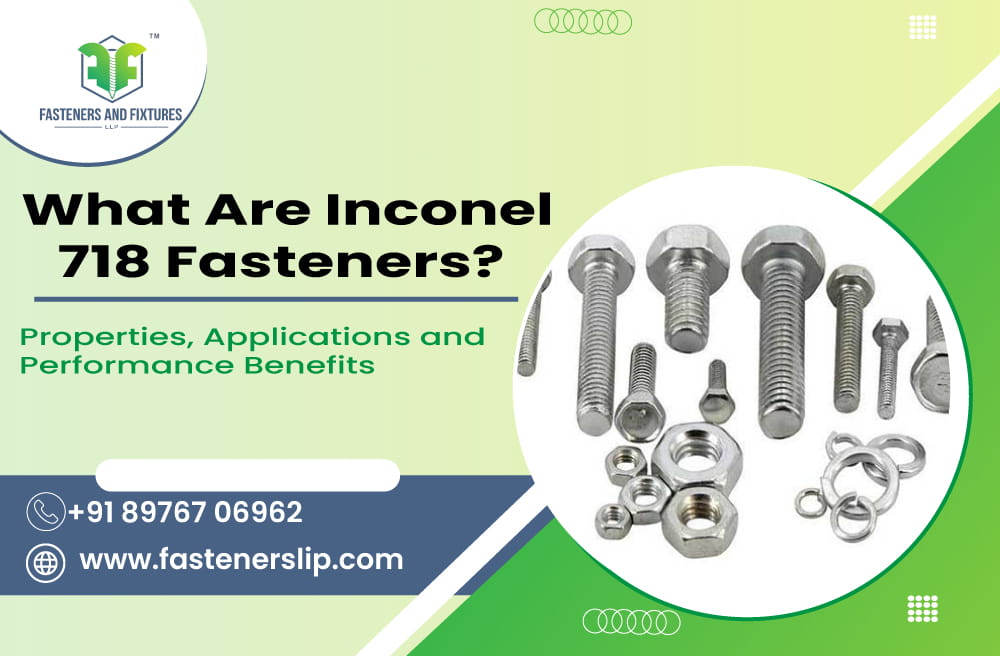
What Are Inconel 718 Fasteners? Properties, Applications and Performance Benefits

In the fields where extreme temperatures, corrosive environments and heavy mechanical loads are commonplace in routine operations, conventional fastening materials are often unable to ensure long-term reliability. This is the reason why Inconel 718 fasteners come into play as a top solution. The company is known for its exceptional durability, strength and resistance to oxidation and long-lasting these fasteners are extensively employed in the marine, aerospace oil and gaz, power generation and chemical processing industries.

In Fastners LLP, we manufacture and distribute high-end Inconel 718 fasteners specifically designed to meet the stringent specifications of crucial industrial applications across the globe. We will explore the characteristics of Inconel 718 fasteners, the most important properties they possess, application, as well as performance advantages.

What Are Inconel 718 Fasteners?

Inconel 718 Fasteners are fastening components manufactured from Inconel 718, a nickel-chromium-based superalloy known for its outstanding mechanical properties and resistance to extreme environments. It is a mixture of iron, nickel, chromium molybdenum and niobium. Aluminum, titanium which creates a unique mix of strength and resistance to corrosion.

These fasteners come in many forms, such as:

  • Bolts
  • Nuts
  • Screws
  • Washers
  • Stud Bolts
  • Threaded Rods
  • Anchor Fasteners

Of the many, Inconel 718 bolts are especially sought-after due to their ability to ensure structural integrity even when pressure is high and temperatures.

Chemical Composition of Inconel 718

The outstanding efficiency of Inconel 718 is due to its chemical composition that is carefully balanced:

  • Nickel (50-55%)
  • Chromium (17-21%)
  • Iron (Balance)
  • Niobium (4.75-5.5%)
  • Molybdenum (2.8-3.3%)
  • Titanium (0.65-1.15%)
  • Aluminum (0.2-0.8%)

This formulation allows precipitation hardening that significantly increases the durability and strength of the product.

Key Properties of Inconel 718 Fasteners

1. Exceptional High-Temperature Strength

One of the main features that distinguishes Inconel 718 fasteners is their capacity to maintain high tensile and yield strength even at temperatures of 700 degrees Celsius and above. Contrary to traditional stainless steel fasteners, these are not affected by mechanical instability when exposed to heat for long periods of time.

2. Superior Corrosion Resistance

Inconel 718 has excellent resistance to:

  • Oxidation
  • Chloride-induced corrosion
  • Sulfidation
  • Pitting corrosion
  • Crevice corrosion

This is what makes Inconel 718 bolts perfect to be used on offshore structures, chemicals plants and marine environments.

3. Outstanding Fatigue Resistance

Industrial equipment is often subject to high-frequency vibration and cyclic load. Inconel 718 offers the highest strength for fatigue, and guarantees the longest service life, even with stress variations.

4. Excellent Creep Resistance

At high temperatures, many substances deform because of creep. Inconel 718 fasteners provide an exceptional resistance to creep deformation which makes them ideal for turbine engines as well as high temperature processing equipment.

5. High Mechanical Strength

The alloy is extremely strong in yield and tensile strength when in comparison to traditional fastening material. This allows engineers to utilize smaller fasteners, without compromising their performance.

6. Good Weldability

Contrary to some alloys with high strength, Inconel 718 is a great weldable alloy with excellent fabrication capabilities which makes it easy to incorporate into complicated assemblies.

Applications of Inconel 718 Fasteners

Because of their distinct capability to perform, Inconel 718 Fasteners are utilized in a variety of high-demanding industries.

Aerospace Industry

The aerospace industry extensively uses Bolts made of Inconel 718 in:

  • Aircraft engines
  • Turbine turbine components
  • Exhaust systems
  • Structural assemblies
  • Rocket propulsion systems

Their capability to withstand extreme temperatures and mechanical stress is crucial for critical applications in flight.

Oil and Gas Industry

Petroleum and gas activities typically include corrosive chemicals and exposure to seawater and extreme pressures. Fasteners made of Inconel 718 are often employed in:

  • Offshore drilling rigs for drilling
  • Subsea equipment
  • Valves and pumps
  • Heat exchangers
  • Pressure vessels

Marine Industry

Marine environments are extremely corrosion-prone due to exposure to saltwater. Inconel 718 fasteners are extremely resistant to corrosion in seawater. They are often employed in:

  • Shipbuilding
  • Propulsion systems for marine vessels
  • Offshore platforms
  • Underwater equipment

Power Generation

For power plant applications, it is necessary to have fasteners that are capable to operate under extreme tensions and temperatures. Examples of applications include:

  • Gas turbines
  • Steam turbines
  • Nuclear power plants
  • Systems for heat recovery

Chemical Processing Industry

Chemical plants use aggressive chemicals which can rapidly degrade conventional fasteners. Inconel 718 has superior resistance to corrosive chemicals. This makes it ideal for:

  • Reactors
  • Processing vessels
  • Chemical pipelines
  • Industrial furnaces

Performance Benefits of Inconel 718 Fasteners

Increased Equipment Reliability

The excellent mechanics of Inconel 718 fasteners minimize the risk of failures in fasteners, and ensure the same performance of your equipment.

Longer Service Life

A high resistance to fatigue, corrosion and creep increases the life of both fasteners as well as the equipment they encase.

Reduced Maintenance Costs

Since these fasteners require lesser replacements, businesses can benefit from lower maintenance costs and less time to repair.

Enhanced Safety

The most critical applications in the fields of aerospace, power generation, as well as oil and gas require solid solutions for fastening. Bolts made of Inconel 718 offer the security protection needed in high-risk environments.

Better Performance in Extreme Conditions

If exposed to high temperatures, chemicals that are corrosive, or heavy mechanical loads Inconel 718 fasteners continue to be effective in situations where traditional fasteners might fail.

Why Choose Fastners LLP for Inconel 718 Fasteners?

Fastners LLP is a trusted manufacturer and supplier of premium quality Inconel 718 fasteners designed to meet international standards for quality. Our products are made using the most advanced technology and rigorous quality control procedures to guarantee the highest performance and reliability.

We provide:

  • Engineered to perfection Inconel 718 bolts, fasteners and nuts
  • Specifications and custom sizes
  • International quality standards
  • Timely delivery
  • Competitive pricing
  • Technical assistance for industrial applications

Our dedication to excellence and customer satisfaction has made us a top partner for companies that require high-performance fastening options.

When strength, reliability and resistance to corrosion are essential, Inconel 718 Fasteners offer a superior solution. Their outstanding mechanical properties, high temperature stability, and resistance to extreme environments make them perfect for crucial applications across the oil and gas, aerospace as well as power generation, marine and chemical processing.

If you need standard or customized Inconel 718 bolts, Contact Fastners LLP delivers fastening solutions that are guaranteed to be safe, longevity, durability, and long-term performance. Making the investment in premium Inconel 718 fasteners isn’t only a matter of material selection, it’s an assurance of quality and reliability.

FAQ

1. What is Inconel 718 Fasteners for?

Inconel 718 Fasteners are utilized in marine, aerospace oil & gas power generation along with chemical process industries in which the highest strength and durability as well as corrosion resistance are needed.

2. What is it that makes Inconel 718 bolts distinct from steel bolts?

Inconel 718 bolts have substantially higher strength at high temperatures and fatigue resistance as well as corrosion resistance when compared with conventional stainless steel bolts.

3. Are Inconel 718 Fasteners able to Inconel 718 Fasteners withstand high temperatures?

Sure, Inconel 718 Fasteners retain outstanding mechanical properties and structural strength in temperatures of up to 700°C and more.

4. Are Inconel 718 Fasteners able to withstand seawater corrosion?

Yes, they offer excellent resistance to salt spray and chloride-induced corrosion. This makes them perfect for offshore and marine use.

5. Why should you select Fastners LLP for Inconel 718 Fasteners?

Fastners LLP offers high-quality, high-precision Inconel 718 fasteners that are engineered with precision, customizable manufacturing options with international quality standards and timely delivery for industrial applications around the world.

How to Choose a Fastener Manufacturer for Critical Industrial and Infrastructure Projects

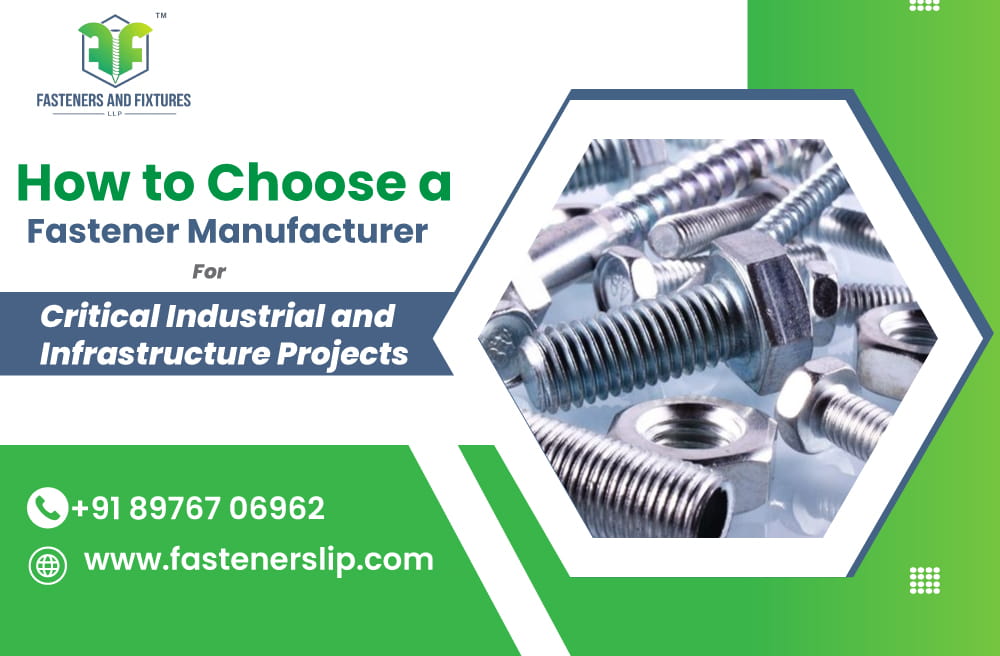
How to Choose a Fastener Manufacturer for Critical Industrial and Infrastructure Projects?

Infrastructure and industrial projects are built upon the highest level of precision, reliability and endurance. It doesn’t matter if it’s an electric power plant, bridge refinery, railway line manufacturing facility, commercial structures, each component is required to perform perfectly under the most challenging conditions. As one of these crucial elements, the fasteners perform an essential function for securing structural integrity as well as the safety of operations.

Selecting the best fastener manufacturer, is therefore, an important decision that will significantly affect the durability, quality and overall achievement of a plan. With a variety of suppliers on the marketplace, procurement managers, project managers and engineers should be sure to evaluate the manufacturers prior to making a choice.

This guide will highlight the essential elements to be considered when selecting an industrial fasteners manufacturer for your critical industrial or infrastructure projects.

1. Evaluate Industry Experience and Expertise

Experience counts when it comes to the production of industrial fasteners. A reliable manufacturer of fasteners that has years of experience is aware of the specific needs of different sectors, including construction, the oil and gas industry, automobile power generation, aerospace and heavy engineering.

A knowledgeable manufacturer can suggest the most appropriate fastener options depending on the load-bearing needs as well as environments, the resistance of corrosion and safety requirements. Businesses with a solid track history are more likely to offer consistent quality and reliable products.

Before you finalize a supplier go over their project portfolio along with industry certifications, as well as customer references to determine their abilities.

2. Check Product Quality Standards

Quality must never be sacrificed in infrastructure projects that require a lot of attention. The chosen industrial fasteners manufacturer must adhere to accepted quality standards at the national and international level.

Make sure you find manufacturers who comply with the requirements of standards like:

  • ISO Certifications
  • ASTM Standards
  • DIN Standards
  • BS Standards
  • IS Standards
  • ANSI Specifications

A reputable manufacturer must also have strict quality control processes all through the process, starting from inspection of raw materials through the final testing of the product.

High-quality fasteners that have been certified by a quality inspector ensure better performance, lower costs for maintenance, and reduce the possibility of structural failures.

3. Assess Manufacturing Capabilities

Different manufacturers are not equipped with the same manufacturing capabilities. Large-scale infrastructure projects usually require fasteners of various dimensions, grades, materials and specifications that are custom.

A reputable manufacturer of fasteners must have modern manufacturing facilities, equipped with cutting-edge technology and machinery. Their manufacturing capabilities include:

  • Bolts
  • Nuts
  • Screws
  • Washers
  • Studs
  • Anchor Fasteners
  • Customized Fasteners

Manufacturers that have integrated production systems can more effectively manage quality as well as meet deadlines and efficiently handle large orders.

4. Verify Material Selection Options

The effectiveness of industrial fasteners greatly depends on the material employed in the manufacturing. Different types of projects require fasteners which are able to withstand extreme temperatures, humidity, chemicals, pressure and corrosion.

A reliable industrial fasteners manufacturer must offer a wide selection of options for materials that include:

  • Stainless Steel
  • Carbon Steel
  • Alloy Steel
  • Brass
  • Copper
  • Titanium
  • High-Tensile Steel

The manufacturer must also assist customers on how to select the appropriate material in accordance with the project’s requirements and the environment.

5. Examine Testing and Quality Assurance Processes

Testing is vital to verify the quality for industrial fasteners. A reputable manufacturer of fasteners invests in stringent tests to confirm the product’s performance.

Common tests are:

  • Tensile Strength Testing
  • Hardness Testing
  • Chemical Composition Analysis
  • Salt Spray Testing
  • Dimensional Inspection
  • Load Testing

Companies with their own testing labs are able to provide thorough quality reports and certificates which give project managers confidence in the product being provided.

6. Consider Supply Chain Reliability

In the event of delays in delivery of fasteners, they can cause delays in project schedules and raise operating costs. Thus, efficiency in the supply chain is a key consideration when deciding on a industrial fasteners producer.

Assess the ability of the manufacturer to:

  • Maintain sufficient levels of inventory
  • Handle large-volume orders
  • Meet tight project deadlines
  • Give prompt support to logistics
  • Ensure uninterrupted product availability

A trusted supplier can help to keep projects on track and minimize the risk of procurement.

7. Look for Customization Capabilities

Each infrastructure project is unique in its engineering specifications. Standard fasteners might not always be able to meet the specific requirements of the design.

A reputable manufacturer of fasteners can provide a range of customized services that include:

  • Special dimensions
  • Custom threading
  • Unique coatings
  • Specialized materials
  • Project-specific designs

Customization capabilities show technical expertise and the capability to support sophisticated industrial applications.

8. Review Technical Support and Customer Service

A reliable manufacturer of industrial fasteners does more than simply supply products. They are an expert partner throughout the life cycle of a project.

Strong customer support includes:

  • Guide to selecting the right product
  • Technical Consultation
  • Assistance with engineering
  • Support for documentation
  • After-sales service

Effective communication and technical expertise will help you solve problems quickly, and help ensure a smooth project implementation.

9. Evaluate Sustainability and Compliance

Modern infrastructure projects are increasingly focusing on sustainability and environmental accountability. Picking a manufacturer of fasteners that adheres to sustainable manufacturing practices can be a great way to support larger sustainable goals.

Look for companies that are that are committed to:

  • Responsible source of raw materials
  • Waste reduction initiatives
  • Energy-efficient production processes
  • Environmental Compliance Regulations

Sustainable manufacturing practices can contribute to the long-term value of business and environmental sustainability.

10. Compare Overall Value, Not Just Price

While cost is a major aspect to consider, selecting a vendor only based on the lowest cost could result in significant risk. Quality-less fasteners can lead to malfunctioning equipment, safety concerns, cost for maintenance, and even project delays.

Instead, consider the total worth of the manufacturers of industrial fasteners and consider the following:

  • Product quality
  • Certifications
  • Expertise in technology
  • Reliability of delivery
  • Customer support
  • Long-term performance

The investment in quality fasteners made by a reputable manufacturer usually yields better returns over the course that the construction project.

Why Choose Fastners LLP?

Fastners LLP has established itself as a reliable manufacturer of fasteners that serves a variety of infrastructure and industrial sectors. With a dedication to high-quality, innovative, and satisfaction of customers, the company offers reliable solutions for fastening to meet the strict requirements of industry.

As a top industrial fasteners producer, Fastners LLP focuses on precision engineering, the latest manufacturing processes, stringent quality control, and prompt delivery. Their wide range of products and their technical know-how make them an ideal partner for projects that require security, durability, and efficiency.

Selecting the best manufacturer of fasteners is a crucial choice that will directly impact the safety of your project, its efficiency, and long-term viability. Through the evaluation of experience, high-quality standards, manufacturing capabilities and materials, as well as methods of testing and supply chain reliability and technical assistance, businesses can find a reliable supplier to meet their infrastructure and industrial requirements.

For companies looking for reliable solutions for fastening, partnering with a seasoned manufacturer of industrial fasteners like Fastners LLP will guarantee high-end quality, reliable performance and long-term project viability.

  1. Why is selecting the right manufacturer of fasteners crucial for industrial projects? 

Picking the best manufacturer of fasteners ensures high-quality products, structural security and compliance with industry standards and long-term reliability for critical applications.

  1. What kind of certifications should an industrial fasteners company have?

 A manufacturer of industrial fasteners should possess ISO certifications as well as conform to ASTM, DIN, ANSI, BS, and IS standards, based on the requirements of the project.

  1. What kinds of materials are used for industrial fasteners? 

The most common materials are carbon steel, stainless steel, alloy steel copper, brass and high-tensile steel.

  1. How do I assess the credibility of a company that makes fasteners?

Check their certifications, facilities for testing manufacturing processes and quality assurance processes as well as their portfolio of projects and reviews from customers.

  1. Why should companies in the infrastructure sector select Fastners LLP?

 Fastners LLP offers high-quality fastening solutions that are engineered with precision, strict quality control, custom capabilities, technical know-how, and timely delivery for important infrastructure and industrial projects.

Bolts vs Screws vs Studs: Understanding the Differences Before You Buy

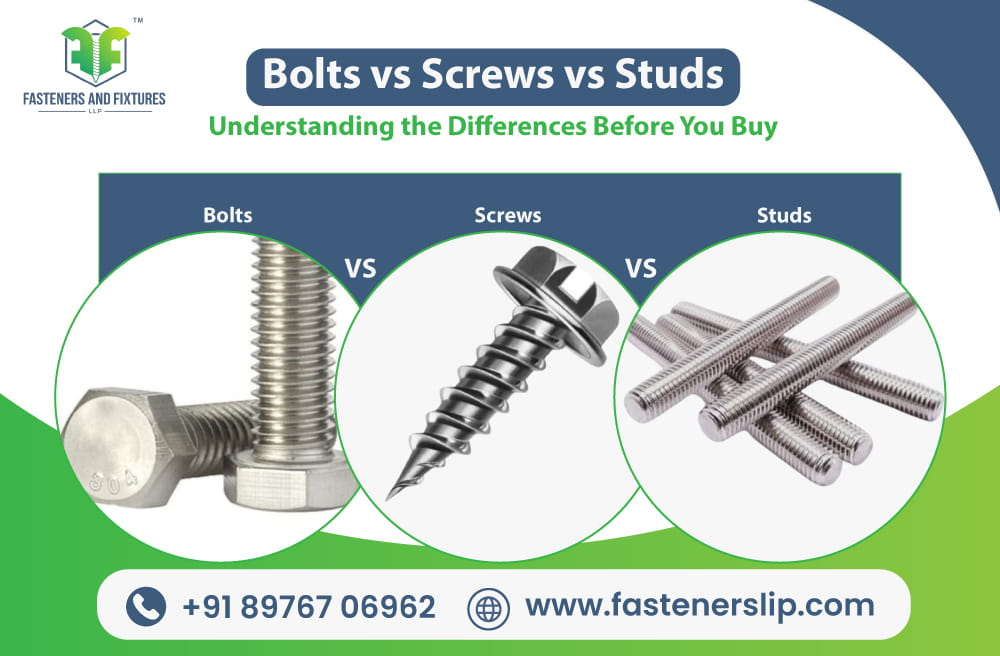
Bolts vs Screws vs Studs: Understanding the Differences Before You Buy?

In the case of industrial fastening solutions, choosing the right part is as important as picking the appropriate material. Although many people refer to the terms in a similar way, bolts vs screws and the studs have three distinctive types of fasteners that are designed specifically for needs. Selecting the wrong type of fastener can cause structural damage and high maintenance costs, downtime for equipment as well as diminished safety.

If you’re involved in manufacturing, construction automobile engineering, oil and gaz, maritime projects as well as heavy machines, knowing the distinctions between bolts, screws and studs will help to ensure maximum performance and long-term durability.

At Fasteners, LLP We manufacture and sell premium-quality industrial fasteners like bolts vs screws vs studs which meet international standards for durability, strength, and accuracy. This guide will explain the main distinctions between screws, bolts and studs, so that you can make an informed choice on the most appropriate fastener solution for your specific project.

What Are Bolts?

Bolts is an externally threaded bolt designed to function in conjunction with a nuts. Bolts are put through holes pre-drilled into two or more parts and secured with a nut to form an elongated mechanical connection.

In contrast to screws, bolts usually need access from both sides to the part.

Common Features of Bolts

  • Need to have nuts that match
  • It is installed through pre-drilled holes
  • Tensile strength high
  • Ideal for applications that require heavy-duty.
  • Available in either fully or partially threaded designs. Available in fully threaded or partially threaded

Common Types of Bolts

  • Hex Bolts
  • Heavy Hex Bolts
  • Carriage Bolts
  • Anchor Bolts
  • Eye Bolts
  • Flange Bolts
  • Structural Bolts
  • U-Bolts

Industries Using Bolts

  • Structural steel construction
  • Bridges
  • Industrial machinery
  • Wind turbines
  • Power plants
  • Marine engineering
  • Mining equipment

Bolts have a great load-bearing capacity and are recommended wherever the highest joint strength is required.

What Are Screws?

The screw is a fastener that has a thread that usually creates the mating thread when being inserted into the substrate. In contrast to bolts, screws generally don’t require a nut.

Based on the type of application the screws can be inserted in wood, metal or plastic, drywall or concrete.

Common Features of Screws

  • Usually, you don’t need nuts
  • Self-threading ability
  • Easier installation
  • Available with different drive types
  • It is suitable for medium to light-duty fastening

Common Types of Screws

  • Machine Screws
  • Self-Tapping Screws
  • Self-Drilling Screws
  • Wood Screws
  • Sheet Metal Screws
  • Drywall Screws
  • Concrete Screws
  • Deck Screws

Industries Using Screws

  • Furniture manufacturing
  • Electronics
  • HVAC systems
  • Interior construction
  • Home improvement
  • Interiors for cars
  • Electrical equipment

Screws are great for areas where simple installation maintenance and speedy assembly are the top priorities.

What Are Studs?

The term “stud” refers to a Stud is an iron rod with threads on both ends, or across its entire length. Instead of a head similar to bolts, a rod is dependent on nuts at either or both ends for the fastening.

Studs offer a high clamping force and are frequently employed in high-temperature, high-pressure industrial environments.

Common Features of Studs

  • No head
  • Threaded at both ends, or fully threaded
  • Requires nuts
  • Great load distribution
  • Easier equipment maintenance

Common Types of Studs

  • Fully Threaded Studs
  • Double-End Studs
  • Tap-End Studs
  • Continuous Thread Studs
  • B7 Studs
  • Stainless Steel Studs

Industries Using Studs

  • Oil & Gas
  • Petrochemical plants
  • Refineries
  • Pressure vessels
  • Heat exchangers
  • Pipe Flanges
  • Heavy industrial equipment

Studs are recommended for situations where frequent removal is required without damaging the hole threaded.

Bolts vs Screws vs Studs: Major Differences

Understanding the differences between bolts vs screws vs studs can be made much simpler by comparing their designs and use.

Feature Bolts Screws Studs
Requires Nut Yes Usually No Yes
Has Head Yes Yes No
Installation Through hole and nuts Threads directly into the material On both sides, nuts
Threading Partial or complete Part or complete Double-ended or full
Load Capacity Very High Medium Very High
Maintenance Moderate Easy Excellent
Typical Applications Heavy structures Sheet metal, wood furniture, sheet metal Flanges, pressure vessels

When Should You Choose Bolts?

Bolts are a great choice for the following situations:

  • A high level of strength is required.
  • The heavy loads involved are
  • Structural integrity is crucial.
  • Components require a solid clamping
  • Access is accessible on both sides

Examples include:

  • Steel structures
  • Industrial machinery
  • Cranes
  • Wind turbines
  • Bridges

When Should You Choose Screws?

Screws are the choice of option for

  • It is crucial to have a quick installation
  • Components are light
  • Regular maintenance is expected.
  • Installation must be done on one side.
  • There is no nut that can be used.

Examples include:

  • Cabinets
  • HVAC ducts
  • Wooden furniture
  • Electrical panels
  • Sheets for roofing

When Should You Choose Studs?

Studs are most effective when:

  • Equipment undergoes regular maintenance
  • The temperatures are high.
  • High pressure is present
  • A second time is needed for assembly.
  • The clamping force must be strong

Examples include:

  • Pipe Flanges
  • Pumps
  • Compressors
  • Boilers
  • Heat exchangers
  • Equipment used in refineries

Material Selection Matters

No matter if you’re using bolts or screws, choosing the appropriate material can significantly affect longevity and performance.

Materials of great interest include:

  • Stainless Steel 304
  • Stainless Steel 316
  • Carbon Steel
  • Alloy Steel
  • Duplex Stainless Steel
  • Super Duplex Steel
  • Inconel
  • Monel
  • Hastelloy
  • Titanium
  • Brass

The right material is determined by the environmental conditions like moisture chemical exposure, saltwater pressure, as well as operating temperature.

Common Mistakes Buyers Make

Many failures of fasteners occur because of poor choice rather than manufacturing defects.

Common errors are:

  • Use screws when bolts are needed
  • The wrong thread pitch to choose
  • Inattention to the tensile strength
  • Selecting incorrect material grades
  • Utilizing undersized fasteners
  • Mixing incompatible metals
  • Over-tightening or under-tightening
  • In ignoring the requirements for corrosion resistance

Partnering with a reputable supplier of fasteners can help you to avoid costly errors.

Why buy at Fasteners LLP?

Fasteners LLP is a trusted manufacturer of high-quality industrial fastening solutions in a variety of industries. Our products are made with high-end engineering, rigorous quality control and in compliance with international standards.

Our range of products includes:

  • Industrial Bolts
  • Industrial Screws
  • Stud Bolts
  • Hex Bolts
  • Anchor Bolts
  • Stainless Steel Fasteners
  • High Tensile Fasteners
  • Custom Fasteners
  • Washers
  • Nuts

Each product is subject to a rigorous inspection to determine dimensional precision and strength, as well as resistance to corrosion and long-term performance.

If your project is related to construction, petrochemicals or power generation, marine engineering and heavy production, Fasteners LLP provides fastening solutions like Premium Quality bolts vs screws vs studs specifically designed to guarantee security and reliability.

Understanding the difference between screws and bolts is vital prior to buying industrial fasteners. All three of them perform the primary task of gluing components, each has an individual purpose, dependent on the design, construction technique, load requirements and maintenance requirements.

Bolts offer exceptional strength, and screws are a great choice for flexibility and convenience while studs offer the highest clamping performance for demanding industrial applications. Picking the correct fastener will not only increase the efficiency of your operation but also improves security, decreases maintenance and extends the lifespan of equipment.

If you’re not sure which the best type of fastener is right for your needs The specialists at Contact Fasteners LLP will help you choose the right product to ensure maximum performance and longevity.

FAQ

1. What is the primary distinction between screws, bolts and studs?

Bolts require a nuts for fixing, while screws make threads that are directly inserted into materials without the need for a nut. Studs are threaded rods that utilize nuts on either or both sides.

2. Which is more durable either a bolt or screw?

Bolts usually have higher load-bearing capacity as well as tensile force than screws which makes them ideal for structural and industrial applications that demand a lot of force.

3. Why are studs being used rather than bolts?

Studs can provide greater load distribution, make it easier to manage maintenance of equipment, and lessen the wear of threaded holes making them suitable for Flanges, pressure vessels and applications that require high temperatures.

4. Which industries are most likely to employ screws, bolts, and studs?

They are used extensively in the construction, automotive marine, aerospace oil & gas manufacturing, petrochemicals power generation, and the heavy industry.

5. What should I consider when choosing the correct industrial fastener?

Select the best fastener based on the load capacity and compatibility with the material and conditions in the environment such as corrosion resistance operating temperature, installation technique, and needs. A trusted supplier such as Fasteners LLP can ensure you get the most effective option for fastening your specific project.

Why Fastener Failure Happens and What Industries Can Do to Prevent It

Why Fastener Failure Happens and What Industries Can Do to Prevent It?

They are one of the crucial elements of engineering for industrial use, but they are frequently overlooked until there is a problem. From oil refineries and bridges to heavy machinery, automobiles, and even cars, industrial fasteners Supplier are essential in securing structures and equipment to each other. When a bolt or screw is damaged, the results can vary from production interruption to catastrophic damage to equipment as well as security risks.

Knowing the causes of fastener failure is crucial for companies in the construction industry, manufacturing as well as energy facilities and maintenance teams looking to improve reliability of operations and cut down on maintenance expenses.

 In this guide we at Fasteners LLP outline the most common reasons behind failures of fasteners as well as the preventive measures that industries can take to ensure lasting performance.

What Is Fastener Failure?

Failure of a fastener is the failure for a bolt to perform its intended purpose due to wear, damage or improper installation. It could also be due to environmental conditions. Failure isn’t always the bolt is broken, but it could mean the loosening of bolts, corrosion, fatigue cracks, stripped threads or the loss of the force of clamping.

A single failure of a fastener could compromise the strength of the entire assembly.

Common Causes of Fastener Failure

1. Incorrect Material Selection

One of the main reasons for the failure of a fastener is selecting the incorrect material for the job. Fasteners that are exposed to corrosive saltwater, extreme temperatures require special materials such as stainless steel Duplex stainless steel and Inconel Monel or Hastelloy.

Using carbon steel fasteners for marine environments, for example, could lead to an immediate corrosion process and premature loss of performance.

2. Improper Torque During Installation

The application of too much or not enough torque can significantly impact the performance of fasteners.

  • Insufficient tightening of the fastener pushes it to the point of no return.
  • Under-tightening reduces clamping force, allowing vibration-induced loosening.

Using torque tools that are calibrated and adhering to manufacturer specifications help to ensure proper preload.

3. Corrosion

Corrosion can weaken the cross-section of the fastener and decrease load-bearing capacity.

Common types include:

  • Uniform corrosion
  • Galvanic corrosion
  • Crevice corrosion
  • Pitting corrosion
  • Cracks in stress corrosion

Choose the corrosion resistant Industrial fasteners and coatings with protective coatings dramatically extends their service life.

4. Fatigue Failure

Fasteners that are subjected to frequent loading and unloading eventually form microscopic cracks.

Over time, the cracks grow until a sudden rupture takes place.

Industries that are affected include:

  • Automotive
  • Aerospace
  • Railways
  • Wind Energy
  • Heavy Equipment Manufacturing

Proper preload and selecting high-fatigue-strength fasteners minimize fatigue-related failures.

5. Vibration and Dynamic Loads

Machines that operate under constant vibration slowly reduce tension on threaded fasteners.

Examples include:

  • Compressors
  • Pumps
  • Mining Equipment
  • Construction Machinery
  • Industrial Motors

Lock washers, torque nuts, thread-locking substances and correct tightening techniques aid in preventing loosening.

6. Hydrogen Embrittlement

High-strength steel fasteners may absorb hydrogen during electroplating or acid cleaning.

This leads to internal brittleness and unintentional fractures under normal loads.

Utilizing controlled manufacturing processes as well as the appropriate heating treatment minimizes the chance.

7. Thread Damage

Threads damaged or poorly constructed decrease the distribution of load.

Thread stripping can be attributed to:

  • Cross-threading
  • Dirt contamination
  • Poor machining
  • Incorrect tightening

Make sure to inspect threads prior to installation.

8. Overloading

Each fastener is rated according to shear and tensile strength.

Utilizing too large fasteners or exposing them to loads that exceed their capacity causes permanent fracture or deformation.

Engineering calculations should always help determine the correct size and the appropriate grade.

Industries Most Affected by Fastener Failure

Oil & Gas

High pressure, corrosive chemicals and offshore environments call for the highest-quality industrial fasteners.

Construction

Structural bolts are used to ensure the stability of bridges, structures and other infrastructure.

Power Generation

Power plants require fasteners that are reliable and capable of handling temperatures up to a high temperature as well as thermal cycles.

Chemical Processing

Chemical plants rely on corrosion-resistant fasteners that can resist the abrasive media.

Marine Industry

The corrosion caused by saltwater makes stainless steel as well as duplex fasteners indispensable.

Automotive Manufacturing

Fasteners are subject to constant stress, vibrations and fluctuating temperatures.

Aerospace

Aircraft require precision-engineered fasteners that have outstanding strength-to-weight ratios as well as fatigue resistance.

Warning Signs of Fastener Failure

Early detection can save you from costly repairs.

Keep an eye out for:

  • Rust formation
  • Loose bolts
  • Cracked washers
  • Thread damage
  • Visible deformation
  • Preload not loaded
  • Unusual vibrating
  • Noise during operation
  • Leaking flange joints
  • Surface pitting

Regular inspections can significantly prevent the chance of unexpected failures.

How Industries Can Prevent Fastener Failure

Choose the Right Material

Pick fasteners according to:

  • Operating temperature
  • Corrosion exposure
  • Mechanical load
  • Pressure needs
  • Chemical compatibility

Partnering with reputable fastener suppliers will ensure that you get the right material.

Use Correct Torque Values

Use the recommended torque specifications.

Employ:

  • Torque wrenches
  • Hydraulic tensioners
  • Digital torque monitoring systems

Consistent tightening improves joint reliability.

Perform Regular Inspection

Maintenance teams should examine fasteners before scheduled shut downs.

The methods of inspection are:

  • Visual inspection
  • Ultrasonic testing
  • Inspection of magnetic particles
  • Dye penetrant testing

Predictive maintenance is a way to identify potential issues before they become a problem.

Apply Protective Coatings

Protective finishes enhance corrosion resistance.

Common coatings are:

  • Zinc Plating
  • Hot Dip Galvanizing
  • PTFE Coating
  • Xylan Coating
  • Cadmium Coating (where allowed)

The selection of coatings is contingent on the operating conditions.

Prevent Vibration Loosening

Consider:

  • Lock nuts
  • Belleville washers
  • Nord-Lock washers
  • Thread-locking adhesives
  • Double-nut systems

These solutions enhance joint security in vibrating equipment.

Purchase High-Quality Industrial Fasteners

Always buy from reliable manufacturers that meet international standards like:

  • ASTM
  • DIN
  • ISO
  • ASME
  • BS Standards

Accredited Industrial fasteners ensure the same mechanical performance and the ability to track.

Train Installation Personnel

Even the most expensive fasteners can fail if they are installed incorrectly.

Proper technician training reduces:

  • Cross-threading
  • Over-tightening
  • Under-tightening
  • Incorrect Lubrication
  • Improper alignment

Why Quality Fasteners Matter

Industrial downtime can cost thousands — or even millions of rupees per hour, based on the sector. Making investments in top industry-grade fasteners lowers the cost of maintenance and increases safety in the workplace. It also increases the reliability of equipment and increases the lifespan of equipment.

When you’re building industrial plants or manufacturing heavy equipment or sustaining processes, choosing the correct fastener is a way to invest in the quality of your operations.

Why Choose Fasteners LLP?

Fasteners LLP provides top-quality industrial fasteners specifically designed for the most demanding industrial applications that span oil and gas construction, marine, energy generation and chemical processing manufacturing, and automotive. Through strict control of quality, standards-based international conformance and a broad range of fastening options, Contact Fastners LLP helps businesses to minimize failure of fasteners and maximize the durability, performance and security.

FAQ

1. What is the most frequent reason for failure of a fastener?

The main reason for failure of fasteners is poor installation, specifically improper torque. Over-tightening or under-tightening will dramatically reduce the life of a fastener and weaken joint integrity.

2. What are the best industrial fasteners to avoid the failure of equipment?

The highest-grade Industrial fasteners ensure a solid clamping force, withstand corrosion, withstand vibration and ensure structural stability, decreasing the possibility of unexpected breakdowns in equipment.

3. Which industries are most dependent heavily on the use of industrial screws?

Industries like construction, oil and gas marine, automotive power generation, aerospace mining, chemical processing rely heavily on strong industry fasteners to ensure safety and efficiency in processes.

4. How do I select the most appropriate industrial fasteners?

Select industrial screws according to the compatibility of the material strength of load as well as corrosion resistance and operating temperature as well as pressure requirements, as well as compliance to ASTM, DIN, ISO as well as ASME standards.

5. Why should fasteners be inspected by industries often?

Routine inspections are a great way to detect the presence of corrosion, loosening, cracks, thread damage and thread cracks early to avoid expensive breakage of the fastener and enhancing safety and prolonging the life of equipment.