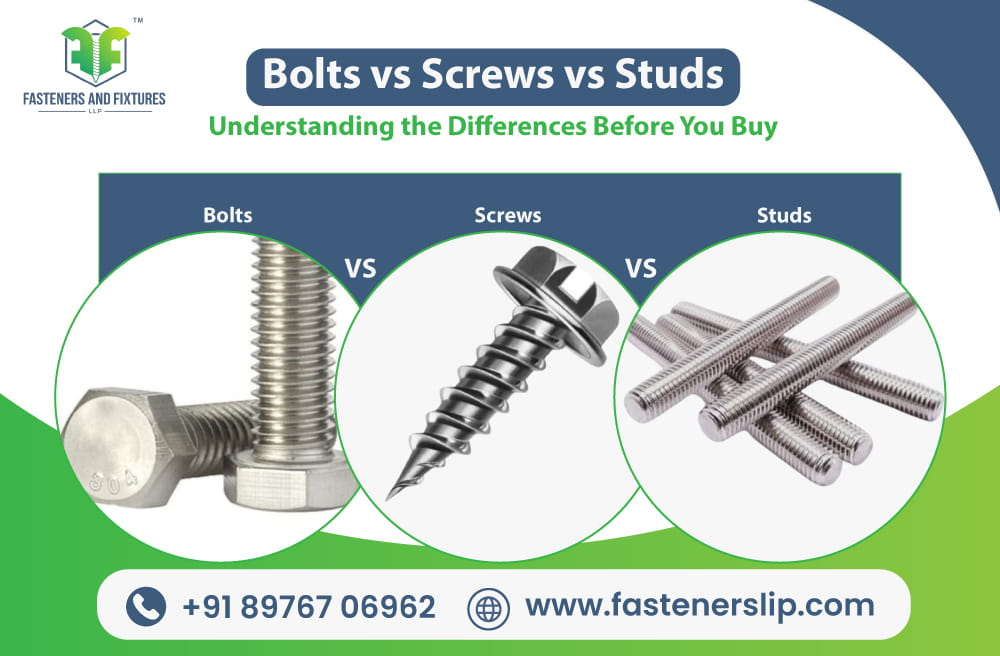
In the case of industrial fastening solutions, choosing the right part is as important as picking the appropriate material. Although many people refer to the terms in a similar way, bolts vs screws and the studs have three distinctive types of fasteners that are designed specifically for needs. Selecting the wrong type of fastener can cause structural damage and high maintenance costs, downtime for equipment as well as diminished safety.
If you’re involved in manufacturing, construction automobile engineering, oil and gaz, maritime projects as well as heavy machines, knowing the distinctions between bolts, screws and studs will help to ensure maximum performance and long-term durability.
At Fasteners, LLP We manufacture and sell premium-quality industrial fasteners like bolts vs screws vs studs which meet international standards for durability, strength, and accuracy. This guide will explain the main distinctions between screws, bolts and studs, so that you can make an informed choice on the most appropriate fastener solution for your specific project.
What Are Bolts?
Bolts is an externally threaded bolt designed to function in conjunction with a nuts. Bolts are put through holes pre-drilled into two or more parts and secured with a nut to form an elongated mechanical connection.
In contrast to screws, bolts usually need access from both sides to the part.
Common Features of Bolts
- Need to have nuts that match
- It is installed through pre-drilled holes
- Tensile strength high
- Ideal for applications that require heavy-duty.
- Available in either fully or partially threaded designs. Available in fully threaded or partially threaded
Common Types of Bolts
- Hex Bolts
- Heavy Hex Bolts
- Carriage Bolts
- Anchor Bolts
- Eye Bolts
- Flange Bolts
- Structural Bolts
- U-Bolts
Industries Using Bolts
- Structural steel construction
- Bridges
- Industrial machinery
- Wind turbines
- Power plants
- Marine engineering
- Mining equipment
Bolts have a great load-bearing capacity and are recommended wherever the highest joint strength is required.
What Are Screws?
The screw is a fastener that has a thread that usually creates the mating thread when being inserted into the substrate. In contrast to bolts, screws generally don’t require a nut.
Based on the type of application the screws can be inserted in wood, metal or plastic, drywall or concrete.
Common Features of Screws
- Usually, you don’t need nuts
- Self-threading ability
- Easier installation
- Available with different drive types
- It is suitable for medium to light-duty fastening
Common Types of Screws
- Machine Screws
- Self-Tapping Screws
- Self-Drilling Screws
- Wood Screws
- Sheet Metal Screws
- Drywall Screws
- Concrete Screws
- Deck Screws
Industries Using Screws
- Furniture manufacturing
- Electronics
- HVAC systems
- Interior construction
- Home improvement
- Interiors for cars
- Electrical equipment
Screws are great for areas where simple installation maintenance and speedy assembly are the top priorities.
What Are Studs?
The term “stud” refers to a Stud is an iron rod with threads on both ends, or across its entire length. Instead of a head similar to bolts, a rod is dependent on nuts at either or both ends for the fastening.
Studs offer a high clamping force and are frequently employed in high-temperature, high-pressure industrial environments.
Common Features of Studs
- No head
- Threaded at both ends, or fully threaded
- Requires nuts
- Great load distribution
- Easier equipment maintenance
Common Types of Studs
- Fully Threaded Studs
- Double-End Studs
- Tap-End Studs
- Continuous Thread Studs
- B7 Studs
- Stainless Steel Studs
Industries Using Studs
- Oil & Gas
- Petrochemical plants
- Refineries
- Pressure vessels
- Heat exchangers
- Pipe Flanges
- Heavy industrial equipment
Studs are recommended for situations where frequent removal is required without damaging the hole threaded.
Bolts vs Screws vs Studs: Major Differences
Understanding the differences between bolts vs screws vs studs can be made much simpler by comparing their designs and use.
| Feature | Bolts | Screws | Studs |
| Requires Nut | Yes | Usually No | Yes |
| Has Head | Yes | Yes | No |
| Installation | Through hole and nuts | Threads directly into the material | On both sides, nuts |
| Threading | Partial or complete | Part or complete | Double-ended or full |
| Load Capacity | Very High | Medium | Very High |
| Maintenance | Moderate | Easy | Excellent |
| Typical Applications | Heavy structures | Sheet metal, wood furniture, sheet metal | Flanges, pressure vessels |
When Should You Choose Bolts?
Bolts are a great choice for the following situations:
- A high level of strength is required.
- The heavy loads involved are
- Structural integrity is crucial.
- Components require a solid clamping
- Access is accessible on both sides
Examples include:
- Steel structures
- Industrial machinery
- Cranes
- Wind turbines
- Bridges
When Should You Choose Screws?
Screws are the choice of option for
- It is crucial to have a quick installation
- Components are light
- Regular maintenance is expected.
- Installation must be done on one side.
- There is no nut that can be used.
Examples include:
- Cabinets
- HVAC ducts
- Wooden furniture
- Electrical panels
- Sheets for roofing
When Should You Choose Studs?
Studs are most effective when:
- Equipment undergoes regular maintenance
- The temperatures are high.
- High pressure is present
- A second time is needed for assembly.
- The clamping force must be strong
Examples include:
- Pipe Flanges
- Pumps
- Compressors
- Boilers
- Heat exchangers
- Equipment used in refineries
Material Selection Matters
No matter if you’re using bolts or screws, choosing the appropriate material can significantly affect longevity and performance.
Materials of great interest include:
- Stainless Steel 304
- Stainless Steel 316
- Carbon Steel
- Alloy Steel
- Duplex Stainless Steel
- Super Duplex Steel
- Inconel
- Monel
- Hastelloy
- Titanium
- Brass
The right material is determined by the environmental conditions like moisture chemical exposure, saltwater pressure, as well as operating temperature.
Common Mistakes Buyers Make
Many failures of fasteners occur because of poor choice rather than manufacturing defects.
Common errors are:
- Use screws when bolts are needed
- The wrong thread pitch to choose
- Inattention to the tensile strength
- Selecting incorrect material grades
- Utilizing undersized fasteners
- Mixing incompatible metals
- Over-tightening or under-tightening
- In ignoring the requirements for corrosion resistance
Partnering with a reputable supplier of fasteners can help you to avoid costly errors.
Why buy at Fasteners LLP?
Fasteners LLP is a trusted manufacturer of high-quality industrial fastening solutions in a variety of industries. Our products are made with high-end engineering, rigorous quality control and in compliance with international standards.
Our range of products includes:
- Industrial Bolts
- Industrial Screws
- Stud Bolts
- Hex Bolts
- Anchor Bolts
- Stainless Steel Fasteners
- High Tensile Fasteners
- Custom Fasteners
- Washers
- Nuts
Each product is subject to a rigorous inspection to determine dimensional precision and strength, as well as resistance to corrosion and long-term performance.
If your project is related to construction, petrochemicals or power generation, marine engineering and heavy production, Fasteners LLP provides fastening solutions like Premium Quality bolts vs screws vs studs specifically designed to guarantee security and reliability.
Understanding the difference between screws and bolts is vital prior to buying industrial fasteners. All three of them perform the primary task of gluing components, each has an individual purpose, dependent on the design, construction technique, load requirements and maintenance requirements.
Bolts offer exceptional strength, and screws are a great choice for flexibility and convenience while studs offer the highest clamping performance for demanding industrial applications. Picking the correct fastener will not only increase the efficiency of your operation but also improves security, decreases maintenance and extends the lifespan of equipment.
If you’re not sure which the best type of fastener is right for your needs The specialists at Contact Fasteners LLP will help you choose the right product to ensure maximum performance and longevity.
FAQ
1. What is the primary distinction between screws, bolts and studs?
Bolts require a nuts for fixing, while screws make threads that are directly inserted into materials without the need for a nut. Studs are threaded rods that utilize nuts on either or both sides.
2. Which is more durable either a bolt or screw?
Bolts usually have higher load-bearing capacity as well as tensile force than screws which makes them ideal for structural and industrial applications that demand a lot of force.
3. Why are studs being used rather than bolts?
Studs can provide greater load distribution, make it easier to manage maintenance of equipment, and lessen the wear of threaded holes making them suitable for Flanges, pressure vessels and applications that require high temperatures.
4. Which industries are most likely to employ screws, bolts, and studs?
They are used extensively in the construction, automotive marine, aerospace oil & gas manufacturing, petrochemicals power generation, and the heavy industry.
5. What should I consider when choosing the correct industrial fastener?
Select the best fastener based on the load capacity and compatibility with the material and conditions in the environment such as corrosion resistance operating temperature, installation technique, and needs. A trusted supplier such as Fasteners LLP can ensure you get the most effective option for fastening your specific project.