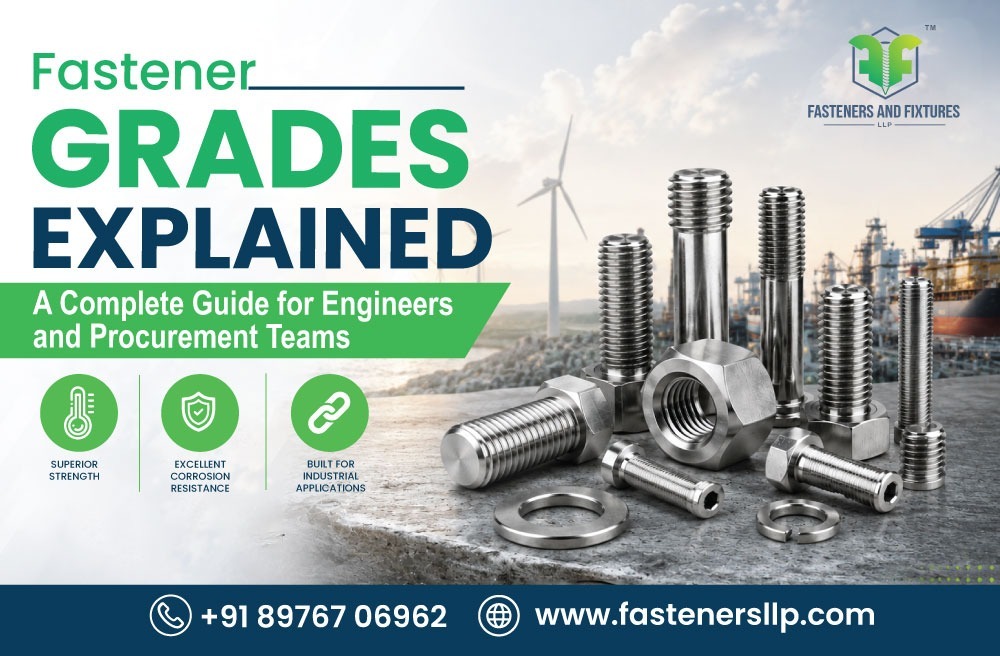
Selecting the correct fastener is not simply about choosing the right bolt size or thread. For engineers and procurement teams, fastener grade is one of the most important specifications because it determines the mechanical strength, load-carrying capability, and suitability of a fastener for a particular application. Choosing an inappropriate grade can lead to premature failure, joint loosening, deformation, or even serious equipment damage.
This Fastnersllp exclusive industrial fasteners guide explains bolt grades, including Bolt Grade 8, Grade 5 bolt strength, SAE classifications, metric property classes, and how procurement teams can use a Fastener Grade chart to make better purchasing decisions.
What Is a Fastener Grade?
A fastener grade identifies the mechanical performance requirements of a bolt, screw, stud, or similar threaded component. Depending on the applicable standard, the grade or property class can relate to tensile strength, yield strength, hardness, material chemistry, heat treatment, and other requirements.
For example, SAE J429 establishes mechanical and material requirements for inch-series steel bolts, screws, studs, and U-bolts. The standard covers fasteners up to specified size limits and defines mechanical requirements according to grade.
Metric fasteners use a different designation system. Standards such as ASTM F568M recognize property classes including 4.6, 4.8, 5.8, 8.8, 9.8, 10.9 and 12.9.
Therefore, engineers should never assume that an SAE grade and an ISO property class are direct one-to-one equivalents.
Bolt Grades Explained: Grade 2, Grade 5 and Grade 8:
The most commonly discussed SAE steel bolt grades are Grade 2, Grade 5 and Grade 8.
Grade 2
Grade 2 fasteners are generally used for lower-strength applications where extreme tensile or shear loads are not expected. They can be suitable for general-purpose assemblies, light-duty equipment, and applications where high-strength bolting is unnecessary.
The advantage is that they can provide an economical fastening solution when engineering calculations do not require a higher-strength fastener.
Grade 5
Grade 5 bolt strength is considerably higher than that of a standard Grade 2 fastener. Grade 5 bolts are commonly associated with medium- to high-strength applications and are frequently used in automotive, machinery, maintenance, and industrial assemblies.
A commonly referenced minimum tensile-strength value for SAE Grade 5 is approximately 120 ksi, although the applicable specification, diameter, and configuration must always be checked before procurement.
Grade 5 is often an effective choice when engineers need a balance between strength, availability, and cost.
Bolt Grade 8
Bolt Grade 8 represents a higher-strength SAE fastener category. Grade 8 bolts are commonly used where assemblies experience substantial tensile, shear, or preload requirements.
A commonly referenced minimum tensile strength for SAE Grade 8 is approximately 150 ksi. However, actual specification requirements can vary with size and the governing standard.
Grade 8 fasteners are often selected for demanding automotive, heavy-equipment, machinery, and structural applications where higher mechanical performance is required.
SAE Bolt Grade Chart:
The following simplified SAE bolt grade chart is useful as an initial selection reference. It should not replace the governing engineering specification or manufacturer’s test certificate.
| SAE Grade | Typical Minimum Tensile Strength* | General Application |
| Grade 2 | ~74 ksi | General/light-duty applications |
| Grade 5 | ~120 ksi | Medium/high-strength machinery and automotive applications |
| Grade 8 | ~150 ksi | High-strength, heavily loaded applications |
*Values are commonly referenced figures for SAE steel fasteners; requirements can vary by diameter and applicable specification. SAE J429 should be consulted for the exact requirement.
It is also important to understand that tensile strength is not the only consideration. Yield strength, proof load, hardness, fatigue performance, joint design, and service conditions can all influence fastener selection.
Understanding Metric Fastener Grades
Engineers working with metric components will frequently encounter designations such as 8.8, 10.9 and 12.9.
The first number broadly relates to nominal tensile strength, while the second number helps establish the relationship between tensile and yield strength. For example, property class 8.8 is a common high-strength metric fastener classification, while 10.9 and 12.9 represent higher-strength classes.
ASTM F568M notes that several metric property classes have requirements essentially aligned with ISO 898-1, including 4.6, 4.8, 5.8, 8.8, 9.8, 10.9, and 12.9.
Procurement teams should therefore specify the complete standard and property class rather than simply requesting a “high tensile bolt.”
Fastener Grade Chart: What Procurement Teams Should Check
A Fastener Grade chart is useful, but purchasing decisions should go beyond grade alone. A proper purchase specification should consider:
- Fastener standard and grade
- Nominal diameter and length
- Thread type and pitch
- Head style
- Material
- Surface finish or coating
- Tensile and yield requirements
- Proof load where applicable
- Operating temperature
- Corrosion environment
- Required certification and test reports
- Compatible nut and washer grade
This is particularly important because different ASTM specifications cover different fastener applications. For example, ASTM A307 identifies Grade A and Grade B carbon-steel fasteners for specific applications, while ASTM A354 covers quenched-and-tempered alloy-steel fasteners with different strength levels.
How Engineers Should Select the Right Fastener Grade
Engineers should begin with the expected service conditions rather than choosing the strongest available bolt.
First, determine the loads acting on the joint, including tension, shear, vibration, and cyclic loading. Next, identify the required preload and joint design. The fastener grade can then be selected based on the required mechanical properties.
Environmental conditions are equally important. A very high-strength carbon-steel bolt may not be the right choice for an aggressive corrosive environment. In such applications, stainless steel, alloy steel, or specialty alloys may provide a more suitable combination of strength and corrosion resistance.
Temperature must also be considered. Mechanical properties can change with temperature, and standards may place limitations on applications outside their intended service range. SAE J429, for example, notes that its mechanical properties are compiled at approximately 20°C and that applicability depends on material grade and processing.
Why Correct Grade Selection Matters in Procurement
For procurement teams, buying fasteners solely on price can create significant technical and operational risks. Two bolts may look identical externally while having very different mechanical properties.
Purchase orders should therefore clearly identify the applicable standard, grade/property class, dimensions, coating, material, and certification requirements.
A reliable supplier should also be able to provide relevant inspection and material documentation where required. This helps engineers verify that the supplied fasteners meet the specified requirements.
Why Choose Fastnersllp?
For companies looking for a Leading Fastener Grades Manufacturer in Mumbai, Fastnersllp can be positioned as a dependable source for industrial fastening requirements across different applications.
The right supplier should understand that fastener selection is an engineering decision—not simply a product purchase. From standard bolts and high-strength fasteners to application-specific requirements, Fastnersllp can support customers in identifying products according to dimensions, grades, material specifications, and project requirements.
Whether your requirement involves Grade 5, Bolt Grade 8, metric property classes, or other industrial fastening specifications, proper documentation and specification matching are essential for reliable performance.
Understanding fastener grades allows engineers and procurement teams to make informed decisions about strength, performance, reliability and cost. Bolt grades explained through SAE classifications such as Grade 2, Grade 5 and Grade 8 provide a useful foundation, while metric property classes such as 8.8 and 10.9 follow a different designation system.
A Fastener Grade chart should therefore be treated as a starting point rather than the final selection tool. Always verify the governing standard, dimensions, mechanical requirements, service conditions, and certification before placing an order.
For businesses seeking a Leading Fastener Grades Manufacturer in Mumbai, Fastnersllp can help simplify the process of sourcing specification-driven fastening solutions for industrial and engineering applications.
1. What does a fastener grade mean?
A fastener grade indicates the mechanical and material requirements a fastener must meet under a particular standard. Depending on the standard, it can define properties such as tensile strength, yield strength, hardness, and other performance requirements.
2. What is Bolt Grade 8?
Bolt Grade 8 is a high-strength SAE steel fastener grade commonly used for demanding applications. It is generally associated with approximately 150 ksi minimum tensile strength, subject to the applicable specification and size.
3. What is Grade 5 bolt strength?
Grade 5 bolts are commonly associated with approximately 120 ksi minimum tensile strength. They are widely used for automotive, machinery, and industrial applications requiring greater strength than lower-grade general-purpose fasteners.
4. How do I use an SAE bolt grade chart?
An SAE bolt grade chart can provide an initial comparison of common grades such as Grade 2, Grade 5, and Grade 8. However, engineers should verify the exact requirements in the applicable SAE specification before final selection.
5. Where can I source fastener grades in Mumbai?
Businesses can approach Fastnersllp for fastener requirements in Mumbai and specify the required grade, dimensions, material, finish, standard and application. Providing complete technical specifications helps ensure the correct fastener is supplied.