
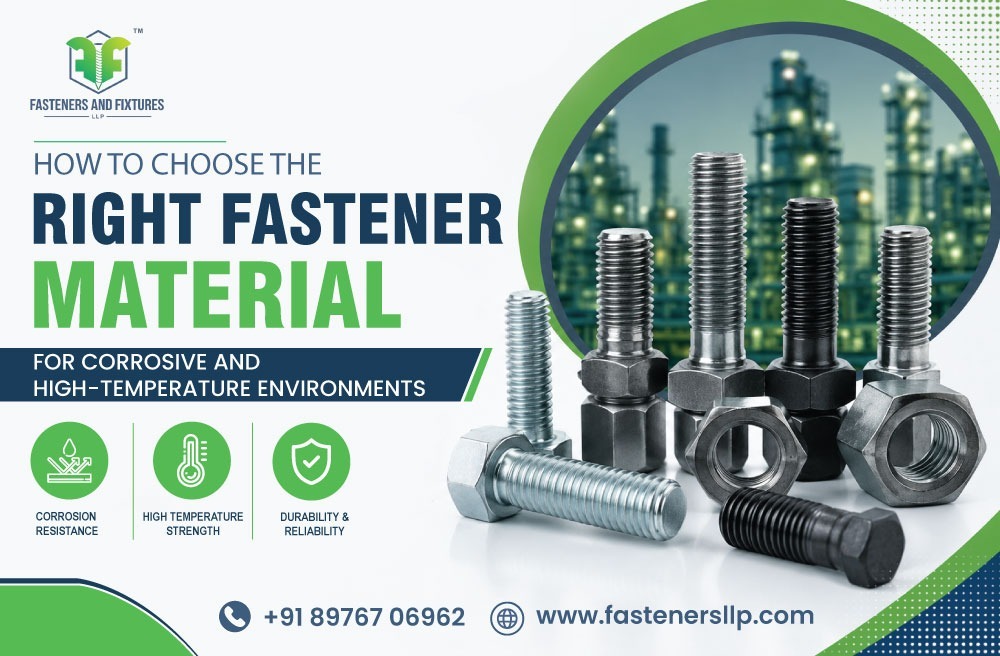
Fasteners may be small components, but they play a critical role in maintaining the safety, strength, and reliability of industrial equipment. In corrosive and high-temperature environments, selecting the wrong bolt, nut, stud, screw, or washer material can lead to corrosion, loss of mechanical strength, thread damage, leakage, and premature joint failure. Therefore, choosing the right fastener material requires careful consideration of temperature, chemical exposure, mechanical loads, and operating conditions.
For industries such as oil and gas, petrochemicals, power generation, marine, chemical processing, pharmaceuticals, and heavy engineering, high-performance fasteners are essential. Fasteners and Fixtures LLP provides fasteners in stainless steels, nickel alloys, duplex and super duplex steels, carbon steels, and other specialty materials for demanding applications.
Why Fastener Material Selection Matters
A fastener must retain its mechanical properties and resist environmental degradation throughout its service life. Corrosion can reduce the effective cross-section of a fastener, damage threads, and compromise preload. At elevated temperatures, materials may experience reduced strength, oxidation, creep, or thermal expansion.
The ideal material therefore needs to balance:
- Corrosion resistance
- High-temperature strength
- Tensile and yield strength
- Resistance to oxidation and chemical attack
- Compatibility with mating components
- Dimensional stability
- Cost and availability
- Applicable industry standards
A Leading Fastener Manufacturer in India should be able to help customers match the fastener grade with the actual operating environment rather than simply recommending the most expensive material.
Step 1: Identify the Corrosive Environment
The first step is understanding what type of corrosion the fastener will encounter. Moisture, salt water, chlorides, acids, alkalis, chemicals, and industrial gases can affect different materials in different ways.
For general atmospheric and industrial applications, stainless steel fasteners can provide good corrosion resistance. SS 304 is commonly considered for moderately corrosive conditions, while SS 316 and 316L offer improved resistance where chlorides and marine exposure are concerns. Fasteners and Fixtures LLP lists stainless steel grades including 304, 304L, 316, 316L, 309, 310, 317L, 321, and 347.
For more aggressive environments, duplex and super duplex stainless steels or nickel-based alloys may be more appropriate. The final selection should always be based on the specific chemical composition, concentration, temperature, and exposure duration.
Step 2: Consider Operating Temperature
Temperature is just as important as corrosion resistance. A material that performs well at room temperature may not retain the same strength at elevated temperatures.
For high-temperature applications, grades such as stainless steel 309, 310, 321, and 347 may be considered depending on the service conditions. Nickel-based alloys such as Inconel, Hastelloy, and Monel can also be selected for specialized environments requiring combinations of heat, corrosion, and mechanical resistance.
Fasteners and Fixtures LLP specifically supplies exotic-grade fasteners, including high-nickel and specialty alloys, for stringent applications such as power plants, refineries, HVAC and thermal systems, and heavy engineering projects.
However, there is no universal “high-temperature fastener.” Engineers should evaluate the actual continuous and peak temperature, thermal cycling, load conditions, atmosphere, and applicable material specifications.
Step 3: Match the Material to Mechanical Loads
Corrosion and temperature are not the only considerations. Fasteners must also withstand tensile loads, shear forces, vibration, pressure, and thermal stresses.
High-strength alloy steel fasteners can be suitable for applications demanding high mechanical strength, while stainless steel, duplex stainless steel, and nickel alloys may be selected when corrosion resistance is equally important.
The fastener’s mechanical properties should be checked against the project specification and applicable standards. The bolt, nut, and washer combination should also be compatible so that the joint performs as an integrated system.
Step 4: Understand Thermal Expansion and Creep
High-temperature equipment can experience repeated heating and cooling. Different materials expand and contract at different rates. If the fastener and connected components have significantly different thermal expansion characteristics, joint preload can change during operation.
Creep is another consideration at elevated temperatures. Under sustained load, some materials can gradually deform, reducing clamping force. For critical high-temperature applications, engineers should therefore consider creep resistance and long-term mechanical performance rather than relying only on room-temperature tensile strength.
Step 5: Select Between Stainless Steel, Duplex and Nickel Alloys
A simplified material-selection approach can help narrow the options:
Stainless Steel Fasteners: Suitable for many general corrosion-resistant applications. SS 304/304L is widely used, while SS 316/316L is often preferred for more chloride-prone environments.
Duplex and Super Duplex Fasteners: Useful where higher strength and enhanced corrosion resistance are required. These materials are frequently considered for demanding chemical, marine, oil and gas applications.
Nickel Alloy Fasteners: Appropriate for highly demanding environments involving elevated temperatures, aggressive chemicals, oxidation, and severe corrosion. Fasteners and Fixtures LLP lists materials including Hastelloy, Monel, and Inconel among its product range.
Alloy Steel Fasteners: Often selected where mechanical strength and resistance to high loads are primary requirements, particularly when environmental conditions are controlled or protective coatings are appropriate.
Step 6: Check Standards, Testing and Traceability
Material selection should always be supported by appropriate documentation. Buyers should verify the material grade, dimensions, mechanical properties, heat treatment, applicable standard, and test requirements.
For critical industrial fasteners, Mill Test Certificates (MTCs), inspection reports, and third-party testing may be required. Fasteners and Fixtures LLP states that it provides material documentation including EN 10204 3.1 and 3.2 certificates, along with third-party and laboratory testing options.
Working with a Top Fastener Supplier in India that understands documentation and traceability can reduce the risk of receiving an incorrect or inconsistent material grade.
Step 7: Consider Galvanic Compatibility
When two dissimilar metals come into contact in the presence of an electrolyte, galvanic corrosion can occur. Therefore, the fastener should be evaluated alongside the material of the equipment or structure being joined.
For example, selecting a highly corrosion-resistant alloy fastener does not automatically eliminate corrosion risks if it is paired with an incompatible material in a wet or salty environment. Proper material matching, insulation, coatings, and joint design may be necessary.
Why Choose Fasteners and Fixtures LLP?
Choosing a reliable supplier is as important as selecting the correct grade. Fasteners and Fixtures LLP offers bolts, nuts, studs, washers, screws, and customized fasteners across stainless steel, nickel alloys, duplex, super duplex, and other specialty materials. Its website states that its manufacturing facility is located in Navi Mumbai and that it serves demanding industries including oil and gas, refineries, power plants, marine, pharmaceuticals, and heavy engineering.
The company also highlights quality testing, material traceability, inspection support, warehousing, and fast delivery for industrial requirements.
For buyers looking for the Best Fastener Stockist in India, factors such as inventory depth, material availability, certification, dimensional accuracy, technical support, and delivery capability should be considered alongside price.
Final Thoughts
Choosing the right fastener material for corrosive and high-temperature environments is an engineering decision, not simply a purchasing decision. Start by evaluating corrosion exposure, operating temperature, mechanical loads, thermal cycling, chemical compatibility, and required standards. Then select a material that provides the necessary combination of strength, corrosion resistance, and temperature performance.
Whether you require stainless steel, duplex, super duplex, alloy steel, Inconel, Hastelloy, Monel, or another specialty grade, working with an experienced supplier can help ensure that the selected fasteners meet project requirements.
Fasteners and Fixtures LLP aims to provide engineered fastening solutions for demanding industrial applications, making it a suitable option for companies seeking a Leading Fastener Manufacturer in India, Top Fastener Supplier in India, and Best Fastener Stockist in India.
FAQs About Fastener Material Selection
1. What is the best fastener material for corrosive environments?
There is no single best material for every corrosive environment. Stainless steel such as SS 316/316L, duplex, super duplex, or nickel alloys may be selected depending on chemicals, chloride exposure, temperature, and mechanical requirements.
2. Which fasteners are suitable for high-temperature applications?
High-temperature applications may require specialized stainless steels, alloy steels, or nickel-based alloys such as Inconel and Hastelloy. The correct grade depends on operating temperature, loading, atmosphere, and corrosion conditions.
3. How do I choose the right fastener grade?
Evaluate temperature, corrosion exposure, tensile and shear loads, vibration, thermal cycling, mating materials, standards, and required certifications before selecting the fastener grade.
4. Why are nickel alloy fasteners used in extreme environments?
Nickel alloy fasteners can provide excellent resistance to heat, oxidation, and aggressive corrosion. They are therefore considered for demanding applications in chemical processing, oil and gas, power generation, and other specialized industries.
5. What should I check before buying industrial fasteners?
Check the material grade, dimensions, applicable standards, mechanical properties, surface finish, heat treatment, certification, MTC, inspection requirements, and supplier’s quality-control capabilities. Choosing an experienced Top Fastener Supplier in India can help ensure reliable and traceable products.