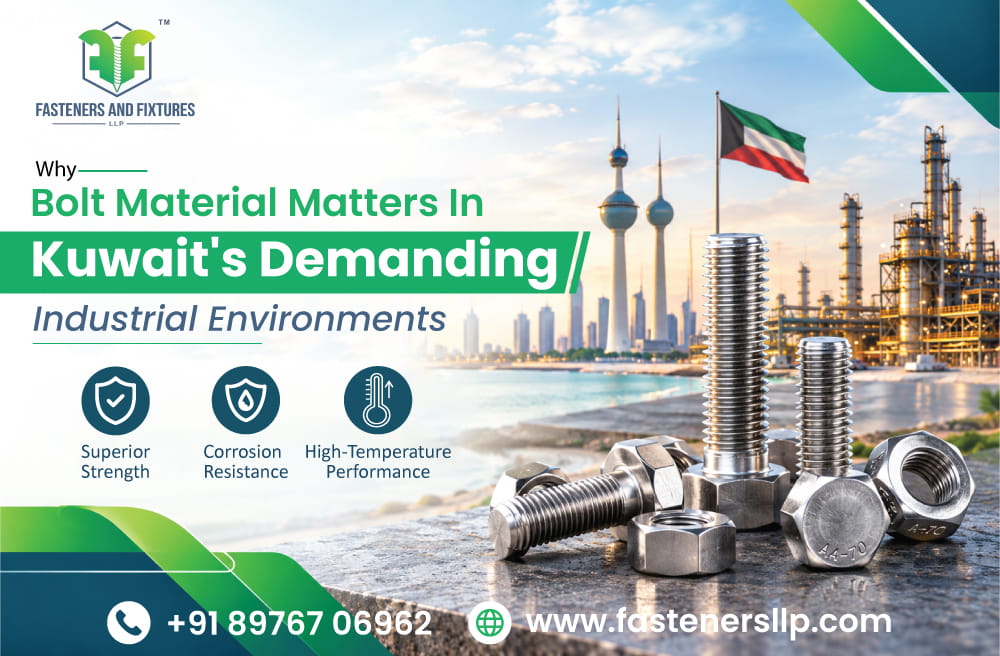
In Kuwait’s demanding industrial environments, a bolt is far more than a small fastening component. It is a critical part of the connection that keeps machinery operational, steel structures stable, pipelines secure, and industrial installations functioning safely. From oil and gas facilities to construction projects, refineries, power plants, and marine infrastructure, the quality of a bolt can influence the performance, reliability, and service life of an entire assembly.
For industrial buyers, engineers, procurement managers, and project contractors, selecting the right bolt material is therefore an important technical decision. A bolt that performs well in a controlled indoor environment may not deliver the same results when exposed to Kuwait’s extreme temperatures, humidity, saline coastal conditions, dust, and corrosive industrial chemicals.
At Fastners and Fixtures LLP, the focus is on helping industrial customers understand why material selection matters and how choosing suitable fastening solutions can support long-term operational reliability. For businesses looking for a dependable bolt manufacturer in Kuwait, understanding bolt materials is a practical starting point for making informed purchasing decisions.
Understanding Kuwait’s Challenging Industrial Conditions
Kuwait presents several environmental challenges for industrial fasteners. Summer temperatures can rise significantly, exposing outdoor equipment and steel structures to intense heat. Coastal installations may experience salt-laden air, while industrial facilities can expose fasteners to moisture, chemicals, and corrosive substances.
These conditions affect different materials in different ways.
Carbon steel bolts, for example, can provide excellent mechanical strength when appropriately specified, but they may require suitable protective coatings to resist corrosion. Stainless steel bolts offer improved corrosion resistance in many environments, although their performance depends on the grade, exposure conditions, and installation requirements.
High-temperature applications may require alloy steel or specialised heat-resistant materials, while chemical processing facilities may need fasteners designed to withstand specific corrosive media.
The key lesson is simple: the strongest bolt is not necessarily the most suitable bolt for every industrial application. The correct material must match the operating environment, mechanical load, temperature, and maintenance requirements.
Why Bolt Material Selection Is So Important
Corrosion Resistance Protects Industrial Investments
Corrosion is one of the major concerns for industrial fastening systems operating in challenging environments. When moisture, oxygen, salts, or chemicals attack a bolt, its surface may deteriorate, potentially reducing its effective cross-section and affecting the integrity of the connection.
In Kuwait, this concern is particularly relevant to coastal infrastructure, marine equipment, outdoor steel structures, and industrial facilities exposed to corrosive substances.
Stainless steel fasteners can be suitable for many corrosion-sensitive applications. Grades such as 304 and 316 are commonly considered, with Grade 316 often preferred where chloride exposure makes additional corrosion resistance desirable. However, neither grade is universally suitable for every chemical or marine environment.
Carbon steel fasteners with appropriate protective coatings may also be effective when selected according to the application and maintenance plan.
For buyers evaluating a bolt manufacturer in Kuwait, material traceability, applicable standards, coating specifications, and clear product documentation should form part of the procurement process.
High Temperatures Can Affect Bolt Performance
Kuwait’s hot climate creates additional challenges for exposed fasteners, particularly when ambient heat combines with elevated operating temperatures generated by industrial machinery, furnaces, engines, or processing equipment.
Temperature can influence material strength, expansion, oxidation, and long-term performance. Different bolt materials respond differently to sustained heat, making application-specific selection essential.
Alloy steel fasteners may be suitable for certain high-load or elevated-temperature applications, provided their grade and heat treatment meet the relevant engineering requirements. Specialised heat-resistant alloys may be necessary in more demanding conditions.
Engineers should also consider thermal expansion and the effects of repeated heating and cooling. These factors can influence joint preload and the reliability of bolted connections.
A suitable bolt specification must therefore account for both the environmental temperature and the actual operating temperature of the equipment.
Mechanical Strength Supports Structural Safety
Bolts are frequently used in applications where they must withstand tensile loads, shear forces, vibration, and fluctuating mechanical stresses.
Industrial machinery, pressure equipment, steel frameworks, and pipeline supports all require fasteners with appropriate mechanical properties.
The material grade determines important characteristics such as tensile strength, yield strength, and hardness. However, strength alone does not guarantee a reliable connection. Thread quality, dimensional accuracy, heat treatment, installation torque, and joint design also matter.
For example, a high-strength bolt installed incorrectly may fail to deliver the expected clamping force. Similarly, using an unsuitable bolt in a vibrating assembly can contribute to loosening or fatigue-related failure.
Industrial purchasers should verify that the selected fastener complies with the engineering specification and the applicable standard, such as ISO, ASTM, or the relevant structural bolting requirements.
Resistance to Vibration and Fatigue Improves Reliability
Oil and gas facilities, pumps, compressors, generators, and heavy industrial machinery can expose bolts to continuous or intermittent vibration.
Repeated loading can gradually initiate fatigue cracks, especially when the material, bolt dimensions, or installation conditions are unsuitable.
Selecting a bolt with appropriate mechanical properties is essential, but fatigue resistance also depends on stress concentrations, thread geometry, joint design, surface condition, and the magnitude of cyclic loading.
Correct tightening procedures and suitable locking arrangements may further improve connection reliability where required by the application.
A knowledgeable bolt supplier can help buyers identify suitable product specifications, while the final selection should be validated against the equipment manufacturer’s recommendations and applicable engineering standards.
Material Compatibility Helps Prevent Premature Failure
Industrial fastening systems often connect components made from different metals. When dissimilar metals come into electrical contact in the presence of an electrolyte, galvanic corrosion may occur under suitable conditions.
This is especially important in humid or saline environments.
For example, combining stainless steel fasteners with certain aluminium components requires consideration of the surrounding environment, the relative positions of the metals in the galvanic series, and any insulating or protective measures.
Material compatibility also matters in chemical processing applications, where a bolt may be exposed to substances that attack either the fastener or the connected equipment.
For this reason, engineers should evaluate the complete bolted joint rather than selecting a bolt material in isolation.
Choosing the Right Bolt Material for Different Industries in Kuwait
Different industrial sectors require different fastening solutions.
- Oil and gas: Fasteners may need to withstand high mechanical loads, temperature fluctuations, vibration, and exposure to corrosive process environments. The required grade should follow the equipment specification and relevant industry standards.
- Construction and infrastructure: Structural bolts must meet specified strength, dimensional, and coating requirements while accounting for outdoor exposure and the expected service life.
- Marine and coastal applications: Corrosion resistance and compatibility with the surrounding materials are particularly important in salt-laden environments.
- Power generation: Fasteners may need to accommodate elevated temperatures, cyclic loading, and vibration around turbines, generators, and associated equipment.
- Chemical processing: Material selection must consider the specific chemicals, their concentrations, operating temperatures, and potential exposure conditions.
For every application, the appropriate choice depends on a combination of engineering requirements, environmental exposure, compliance, and lifecycle cost.
How Fastners and Fixtures LLP Can Support Better Procurement Decisions
Choosing industrial bolts should involve more than comparing prices. Buyers need confidence that the product supplied matches the required material grade, dimensions, mechanical properties, and applicable standards.
Fasteners and Fixtures LLP recognises the importance of informed fastener selection for demanding industrial applications. Businesses evaluating fastening products should establish clear specifications before placing orders and verify that suppliers can provide the necessary technical documentation.
Important procurement checks include:
- Material grade and product identification.
- Applicable ASTM, ISO, or other specified standards.
- Mechanical property and dimensional requirements.
- Heat treatment and coating specifications, where applicable.
- Material test certificates and traceability, when required.
- Suitability for the intended temperature, loading, and corrosive environment.
For businesses searching for a bolt manufacturer in Kuwait, these checks help establish whether a proposed fastening solution meets project requirements. Buyers should also confirm the supplier’s actual manufacturing capabilities, available grades, delivery arrangements, and quality-control processes.
Why Lifecycle Value Matters More Than the Initial Price
A lower-priced bolt may appear economical during procurement, but the overall cost can increase if the fastener corrodes prematurely, requires frequent replacement, or contributes to equipment downtime.
Industrial maintenance can involve labour costs, production interruptions, inspection expenses, and replacement of connected components. In critical installations, the consequences of fastening failure can be even more significant.
Selecting the correct bolt material can help reduce avoidable maintenance and improve the reliability of the assembled equipment. This does not mean that the most expensive material is always the best choice. Instead, the objective is to select a technically suitable material that delivers the required performance at an appropriate lifecycle cost.
For industrial businesses in Kuwait, this approach supports better purchasing decisions and more predictable maintenance planning.
Bolt material matters because Kuwait’s industrial environments demand fastening solutions that can withstand challenging combinations of heat, corrosion, mechanical stress, and vibration.
From carbon steel and stainless steel to specialised alloy fasteners, each material has specific advantages and limitations. The right selection depends on the intended application, environmental exposure, loading conditions, installation requirements, and applicable engineering standards.
Fasteners and Fixtures LLP encourages industrial buyers to approach bolt procurement as a technical decision rather than a price-only exercise. For businesses evaluating a bolt manufacturer in Kuwait, prioritising material suitability, quality documentation, and specification compliance is an important step towards building safer, more reliable, and longer-lasting industrial connections.
1. Why is bolt material important in Kuwait’s industrial environments?
Bolt material determines important performance characteristics, including mechanical strength, corrosion resistance, temperature tolerance, and fatigue behaviour. Selecting the right material helps industrial facilities maintain reliable connections under Kuwait’s demanding environmental and operating conditions.
2. Which bolt material is best for industrial applications in Kuwait?
There is no single best material for every application. Carbon steel may suit structural and general industrial applications, stainless steel can provide corrosion resistance in many environments, and specialised alloy steel or heat-resistant alloys may be required for demanding temperature or loading conditions. The choice should follow the relevant engineering specification.
3. How can industrial buyers choose a reliable bolt manufacturer in Kuwait?
Industrial buyers should evaluate the manufacturer’s or supplier’s product range, quality-control procedures, material traceability, compliance with applicable standards, technical documentation, and ability to meet project specifications. Delivery capability and after-sales technical support may also influence the decision.
4. Are stainless steel bolts suitable for Kuwait’s coastal and marine environments?
Stainless steel bolts can be suitable for many coastal applications. However, performance depends on the grade, chloride concentration, temperature, crevice conditions, and maintenance practices. Grade 316 may offer improved resistance to chloride-related corrosion compared with Grade 304, but more aggressive environments may require alternative materials or additional protection.
5. Which standards should buyers check when purchasing industrial bolts in Kuwait?
Depending on the application, buyers may need to check ASTM, ISO, or other project-specified standards covering dimensions, material composition, mechanical properties, coatings, and testing. Structural, pressure-related, and other safety-critical applications may also have additional industry or equipment-specific requirements.